Caleb Harlan did not believe in signs.
He believed in tire pressure, torque specs, weather reports, timing belts, and the hard fact that if you ignored a warning light long enough, the road would eventually punish you for it.
Anna believed in signs.
Not the mystical kind, exactly, but the small domestic kind that told a person where love had been standing.
A coffee mug left on the porch rail meant Caleb had sat outside before dawn, thinking too much.
A folded towel on the bathroom sink meant he had tried to help, even if he put it in the wrong place.
A clean kitchen after midnight meant he was scared and did not want to wake her.
They lived in a small house on the edge of Tulsa, near Route 66, where freight yards, tire shops, diners, and old motels made the city feel like it was always halfway between leaving and coming home. Caleb worked at a diesel repair shop that opened before sunrise and smelled like rubber, hot metal, oil, coffee, and men pretending their knees did not hurt. He was the guy younger mechanics called when a truck sounded wrong but the computer said everything was fine.
He could hear trouble.
Anna said that was why he had survived so much of his own life.
Before Anna, Caleb had been rougher. He had not been cruel, but he had been careless with himself and with anyone who came too close. His father was a long-haul trucker who treated home like a rest stop. His mother raised three boys on waitressing shifts and cigarette math, trying to stretch paychecks until they screamed. Caleb learned early that men left, engines failed, and promises sounded better before somebody had to pay for them.
Motorcycles gave him a different kind of control.
Not freedom.
He hated that word when people used it lazily.
A bike did not make a man free. A bike made him responsible for every second. One bad decision, one wet curve, one driver looking at a phone, and the road stopped forgiving.
That was why he loved it.
It told the truth.
The Red River Saints were not outlaws, no matter what people whispered when they saw leather cuts outside the diner. They were working men and women, some veterans, some mechanics, some nurses, some truck drivers, all carrying private histories that sat better at sixty miles an hour than around kitchen tables. Their president, a Black American man named Elijah “Deacon” Rowe, had once told Caleb, “A club ain’t where men go to run from home. It’s where men learn why they need one.”
Caleb rolled his eyes then.
Years later, after marrying Anna, he understood.
Anna was the first person who made him want to come home before the tank was empty.
She met him at a county fair, of all places, where he was fixing a generator behind a funnel cake stand and cursing at a wire harness. She told him he had a poet’s vocabulary if the poet hated electricity. He laughed before he meant to, and that startled him enough to look up.
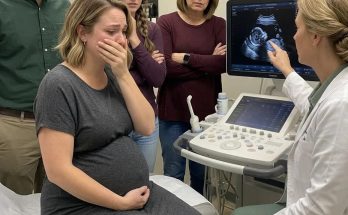
By the time she got pregnant, Caleb was terrified in a quiet, practical way.
He built a crib too sturdy.
Installed the car seat six weeks early.
Packed the hospital bag twice, then repacked it because he did not trust the first version of himself.
He talked to the baby every night because Anna told him babies could hear voices in the womb, and though Caleb pretended he found that suspicious, he started speaking more carefully after that. No yelling at games on TV. No cursing near Anna’s stomach unless he apologized to the baby afterward.
“You’re going soft,” Deacon told him one Sunday outside Pearl’s Diner.
Caleb sipped black coffee and said, “My daughter’s in there growing ears. I got standards now.”
The club laughed.
But nobody laughed at the pink socks on his handlebar.
Anna gave them to him the morning he left for the memorial ride.
They were impossibly small, soft, pink, and folded into his palm like a challenge.
“Take these,” she said.
“What am I supposed to do with socks on a bike?”
“Remember you’re coming back.”
He looked at her belly, then at her face.
“I know that.”
“I know you know. Take them anyway.”
So he clipped them to the handlebar with a tiny silver clamp, right beside the red bandana on the mirror.
The club gave him grief for exactly six minutes.
Then Deacon looked at the socks and said, “Leave the man alone. That’s a compass.”
That was the first seed.
The second was Caleb’s voice.
Every night of the pregnancy, the baby moved when he spoke.
The third was the old lullaby Anna’s grandmother had sung to her, the one Caleb claimed he could not sing but hummed under his breath when he thought nobody was listening.
Anna heard him.
So did the baby.
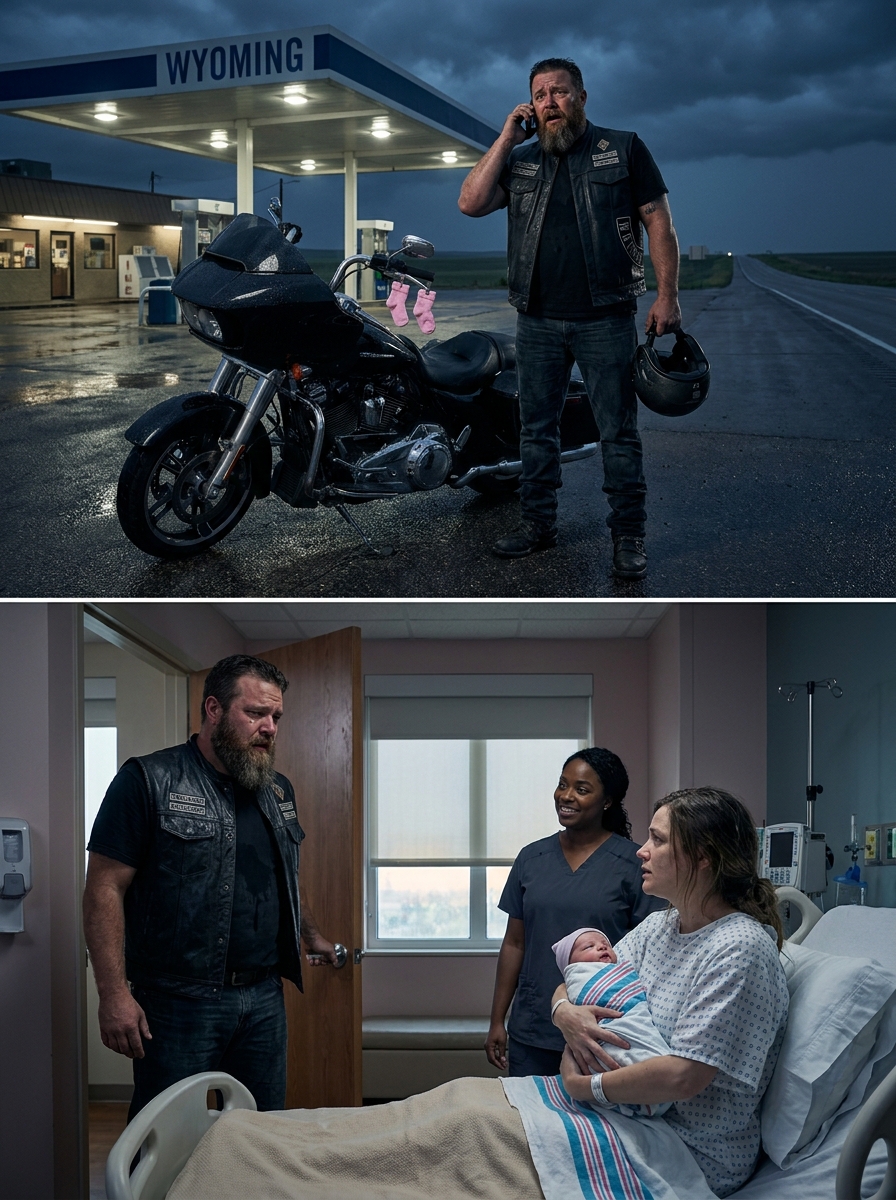
The memorial ride reached Wyoming under a sky that looked too big for human problems.
Caleb loved that part of the country, though he would never say it in a way that sounded poetic. The land opened wide, all brown grass, blue distance, long fences, and clouds that made a man feel temporary in the best and worst ways. The Red River Saints rode in staggered formation, eighteen bikes strong, engines humming beneath the wind, leather snapping, saddlebags full of rain gear and gas station snacks.
They stopped outside Casper just before evening.
Caleb checked his phone.
Three missed calls from Anna.
One from her sister.
One from Mercy General.
For half a second, his mind refused to read the screen correctly.
Then the phone rang again.
Anna.
He answered before the first ring finished.
“Baby?”
Her breathing was different.
That was what scared him most.
Not panic.
Control.
The kind of control that means pain has already walked into the room and taken off its coat.
“My water broke,” she said.
Caleb turned away from the gas pumps.
“You at the hospital?”
“Jenna’s driving me.”
“Contractions?”
“Yeah.”
“How far?”
“Caleb.”
He stopped asking mechanical questions because his wife was not an engine throwing codes.
“I’m coming.”
“You’re a thousand miles away.”
“I’m coming.”
“You can’t make it in time.”
He closed his eyes.
“I’m coming anyway.”
There are moments in a man’s life where the decision does not feel like a decision. It feels like discovering the only road left under your wheels.
Deacon saw Caleb’s face from across the lot and walked over.
“Anna?”
“Labor.”
The club went quiet.
No jokes.
No panic.
Just men and women turning toward the problem.
Deacon looked at the map on his phone.
“Fastest route is ugly.”
“I don’t care.”
“You tired?”
“I don’t care.”
“You will.”
Caleb looked at him.
Deacon nodded once.
“Then we ride smart.”
“I’m not asking—”
“I didn’t hear you ask.”
That was the Red River Saints.
Brotherhood did not always mean following a man into stupidity. Sometimes it meant building a guardrail around his fear.
Three riders went with Caleb for the first two hundred miles. Deacon. A white American woman named Marcy who had ridden iron-butt routes for fun because she had questionable hobbies. A Choctaw American veteran named Len who knew every back road between Wyoming and Oklahoma and trusted no GPS after sunset.
They made him stop for gas.
Made him drink water.
Made him put on rain gear.
Made him call Anna when cell service allowed and shut up when she needed to breathe through contractions.
By 11:40 p.m., Anna was at seven centimeters.
By 12:25, Caleb was crossing into Colorado with rain hitting so hard the road turned silver under his headlight.
By 1:08, Anna screamed into the phone and then apologized for screaming.
Caleb nearly lost it then.
Not on the road.
Inside himself.
He pulled under an overpass while Deacon stood beside him in the rain, one hand on Caleb’s shoulder where Caleb could see it.
“Breathe,” Deacon said.
“My wife is doing this without me.”
“She’s not without you. She’s with nurses, her sister, and every word you ever put into that child’s bones.”
Caleb stared at him.
“That’s the dumbest thing you’ve ever said.”
“Probably. Breathe anyway.”
At 10:06 p.m. Tulsa time, Anna gave birth to a girl.
Six pounds, four ounces.
Dark hair.
Strong lungs.
Furious little fists.
Her name was Clara Rose Harlan.
Caleb was still hundreds of miles away.
He found out at a truck stop near Pueblo.
Anna’s sister sent the first photo.
A red-faced baby wrapped in a striped hospital blanket, eyes squeezed shut, mouth open like she had arrived already complaining about the accommodations.
Caleb sat on the curb outside the truck stop with rain dripping from his beard and cried so hard he could not see the screen.
That was the false climax.
The baby was born.
The father missed it.
The road had beaten him.
At least, that was what he thought.
Then his phone buzzed again.
A message from Anna.
She’s here. She’s perfect. Come meet your daughter.
Caleb stood.
The road was not finished with him yet.
After Clara was born, the nurses cleaned her, weighed her, checked her, wrapped her, and placed her against Anna’s chest. Anna was exhausted in a way that made the ceiling lights look far away, but the moment the baby settled under her chin, the room narrowed to warmth, skin, breath, and the small stunned silence that follows a cry big enough to change a family.
Jenna, Anna’s sister, took pictures.
The doctor said all the right things.
The nurse smiled and said Clara had a good set of lungs.
Anna kept looking at the door.
Not because she expected Caleb to walk in yet.
She knew the distance.
She knew the weather.
She knew him well enough to be afraid of how hard he would try.
At 11:30, the night nurse came in.
Her name was Denise Parker, Black American woman, fifty-six, twenty-nine years in maternity, the kind of nurse who could swaddle a baby, calm a grandmother, correct a doctor, and make a terrified father sit down with one eyebrow.
She checked Anna.
Then checked Clara.
Clara was awake.
Not crying.
Just turning her head.
Toward the door.
Denise smiled.
“Nosy little thing.”
Anna laughed softly.
“Her dad’s nosy too.”
Denise adjusted the blanket.
Clara turned her head again.
Door.
Anna noticed this time.
“What is she doing?”
“Newborns do funny things.”
That was the sensible answer.
And maybe it was true.
But over the next six hours, Clara did it again and again.
When carts rolled past, she turned.
When footsteps paused, she turned.
When a man laughed in the hallway, she went still.
When the door opened and it was only Jenna coming back from the vending machine, Clara squirmed and frowned like the universe had made a clerical error.
Denise saw it.
Anna saw it.
Jenna saw it.
At 2:15, Anna called Caleb.
He answered over the sound of wind.
“Where are you?”
“South of Wichita.”
“You sound awful.”
“You sound beautiful.”
“I just had a baby. I look like a crime scene with lip balm.”
He laughed, and that laugh nearly broke her.
Clara moved against Anna’s chest.
“Talk,” Anna said suddenly.
“What?”
“Talk to her.”
There was a pause.
Then Caleb’s voice changed.
Lower.
Softer.
That same nightly couch voice.
“Evening, little girl,” he said through the phone, through the storm, through whatever invisible place voices travel before they become comfort. “Dad’s late. I know. Bad first impression. But I’m coming. You just hang tight with your mama.”
Clara stopped moving.
Anna looked down.
The baby’s eyes were still closed, but her whole body had gone quiet.
Denise, standing near the monitor, looked at Anna.
Caleb kept talking.
“Truck stops smell bad. Rain’s worse. Your uncles are riding like old ladies because they think I’m stupid. They’re right. Your mama’s tougher than all of us put together.”
Anna cried then.
Not loudly.
She did not have the strength.
Caleb hummed the lullaby next.
Badly.
Off-key.
Half-remembered.
The same tune he had hummed every night beside Anna’s belly.
Clara’s mouth softened.
That was the twist nobody knew yet.
The baby had not been waiting for a face she had never seen.
She had been waiting for the sound she already knew.
The low voice that came through skin, muscle, water, and months of evening rituals. The uneven humming. The man who had talked to her before she had a name, who had told her about bad soup and diesel trucks and how her mother rolled her eyes when he got sentimental.
By 4:08, that voice finally reached the door in person.
Caleb entered Mercy General like a man trying not to bring the whole highway inside with him.
He had stopped at the last gas station outside Tulsa only long enough to wipe his face, change into a dry black shirt from his saddlebag, and scrub his hands in the bathroom until the grease under his nails surrendered as much as it was going to. His leather vest was still damp. His jeans were road-stiff. His boots squeaked on the hospital floor.
The woman at the desk looked up and saw what most people saw first.
Biker.
Big.
Tattooed.
Exhausted.
Possibly trouble.
Then she saw the pink baby socks clipped to the handlebar key in his hand and softened.
“Maternity is second floor,” she said before he asked.
He nodded once.
“Thank you, ma’am.”
Elevators are cruel to men who have ridden a thousand miles. Too slow. Too bright. Too clean. Caleb stood inside that little mirrored box and saw himself fully for the first time since the call: red eyes, wet beard, road grime along his jaw, hands shaking despite every command he gave them.
The doors opened.
He stepped into the maternity ward and froze.
A newborn cried somewhere.
A monitor beeped.
A nurse laughed softly at the desk.
Everything smelled like disinfectant, warm blankets, coffee, and the sharp electric fear of new fathers who do not know where to put their hands.
Denise saw him before he reached the room.
“You Caleb?”
He nodded.
No voice.
She looked him up and down, not judging, just measuring the distance he had crossed.
“You rode all night?”
“Yes, ma’am.”
“Stupid.”
“Yes, ma’am.”
“Dedicated, but stupid.”
“Yes, ma’am.”
She almost smiled.
Then she looked through the small window into room 214.
Anna was awake, sitting up against pillows, hair loose, face pale and beautiful in the brutal fluorescent light. In her arms was the baby.
Caleb could not move.
Denise’s voice softened.
“That little girl’s been turning her head toward the door all night.”
Caleb looked at her.
“Why?”
Denise shrugged, but her eyes were kind.
“Couldn’t tell you medically in a way that won’t sound like a nurse who’s been doing this too long.”
He waited.
She said it anyway.
“Like she was waiting for somebody.”
Caleb covered his mouth.
That was when Anna looked up.
Through the glass.
She saw him.
Her face changed in a way that made the whole ride worth every mile and every mistake.
Caleb opened the door slowly.
Not because he was dramatic.
Because he was terrified.
Anna whispered, “You made it.”
He shook his head.
“I’m late.”
“No.”
“I missed it.”
She looked down at Clara.
“Maybe. But she didn’t stop listening.”
Caleb stepped closer.
The baby stirred.
Not much.
Just a small turn of the head.
Toward him.
That undid him.
He lowered himself into the chair beside the bed like his knees had finally received permission to fail.
Anna shifted the bundle toward him.
“Meet your daughter.”
Caleb held out his hands, then pulled them back.
“They’re rough.”
“She’s new, not made of glass.”
“I smell like road.”
“She’s been waiting on road.”
Anna placed Clara in his arms.
The room went quiet.
Caleb had held engines that weighed half a ton, steel plates hot enough to scar, dying dogs, drunk friends, his wife after miscarriages they did not discuss publicly, and once a stranger’s head after a wreck until the ambulance came.
Nothing had ever scared his hands like six pounds of daughter.
Clara turned her face toward his chest.
Her cheek pressed against the damp black shirt.
Caleb forgot every word he had planned.
So he said the first true thing.
“Hey, little girl.”
Clara went still.
Anna began to cry.
Denise looked away because good nurses know when not to witness too loudly.
Caleb’s voice broke.
“Dad’s home.”
The seeds returned then.
The pink socks.
The nightly talks.
The lullaby.
The way Clara kicked whenever he spoke.
The way she turned toward the door for six hours.
It was not magic, exactly.
Or maybe it was the ordinary kind.
A child knowing the rhythm of a father before knowing his face.
A man thinking he had missed the beginning, only to find that the beginning had included him all along.
Caleb reached into his vest pocket with one hand and pulled out the tiny pink socks, still clipped together, damp at the edges from rain.
Anna laughed through tears.
“You actually kept them on the bike?”
“You told me to bring them back.”
“I told you not as decoration.”
“They guided me.”
“You’re ridiculous.”
“Yes, ma’am.”
He set the socks on the blanket near Clara’s feet.
They were still too big.
That made Anna cry harder.
At 5:12 a.m., Caleb hummed the lullaby again.
Badly.
Still off-key.
Clara slept through it with one fist curled against his vest.
The Red River Saints arrived at the hospital parking lot just after sunrise.
Not all eighteen.
Six.
The rest had sense, jobs, or wives who would not accept “Caleb had a baby” as a reason to ride into Tulsa at dawn. Deacon came. Marcy came. Len came. Three others rolled in behind them, engines low out of respect for hospital windows and sleeping strangers.
They did not go inside at first.
They stood near Caleb’s Harley, which looked like it had dragged a piece of Wyoming weather all the way home. Rain dried in streaks along the fairing. Bugs clung to the windshield. The red bandana hung limp from the mirror. The handlebar looked strange without the pink socks.
Deacon noticed.
He smiled.
“Compass delivered.”
Inside, Anna slept.
Clara slept.
Caleb did not.
He sat in the chair, daughter against his chest, afraid to move and unwilling to do anything else. Every time a nurse came in, he looked guilty, as if he had stolen the baby and expected to be asked for a receipt.
Denise checked on them at 7:00.
“You sleep yet?” she asked.
“No, ma’am.”
“You plan to?”
“Eventually.”
“That baby can sleep in the bassinet.”
Caleb looked down at Clara.
“She can.”
“Will she?”
“Probably.”
“Will you put her there?”
He hesitated.
Denise sighed.
“Bikers are just fathers with worse posture.”
Caleb smiled for the first time since Wyoming.
Later that morning, Deacon came in alone. He removed his hat at the door and stood quietly until Anna waved him closer. He was a large Black American man in his late fifties, gray beard, leather vest, tattooed hands, and eyes that could turn stern or soft depending on need.
He looked at Clara.
Then at Caleb.
“You did good.”
Caleb shook his head.
“Anna did everything.”
Deacon nodded.
“That’s usually how babies work.”
“I missed it.”
Deacon sat in the chair near the window.
“You missed the delivery.”
Caleb looked up.
Deacon continued, “Don’t confuse that with missing her life.”
That sentence stayed.
In the weeks that followed, Caleb repeated it to himself at 2:00 a.m. when Clara would not stop crying and he felt useless. He repeated it when he changed diapers badly. When he warmed bottles too hot. When he installed the car seat again because the angle bothered him. When he went back to work and called Anna on lunch breaks just to ask if Clara had looked toward the door.
She often had.
That became their ritual.
At 5:45 every evening, Caleb’s Harley rumbled into the driveway, and Anna would say, “Daddy’s home.”
Before Clara understood words, she understood the engine.
Her head turned.
Her legs kicked.
Her tiny fists opened.
By six months, she smiled at the sound.
By one year, she slapped both hands against the window when the Harley came around the corner.
By two, she called it “Da thunder.”
The pink socks were framed in a small shadow box above the garage workbench, beside a photo of Caleb holding Clara at 4:20 a.m., road-worn, terrified, and more awake than he had ever been.
Caleb told people the socks were a compass.
Anna told people they were proof he listened.
Both were true.
Five years later, Clara asked for her first ride.
Not a road ride.
Caleb was not that brave yet.
Just the driveway.
Then the church parking lot.
Ten miles an hour, maybe less.
She stood in the garage wearing a helmet too big for her head, pink boots, denim jacket, and the same stubborn chin Anna had worn during labor.
“I’m ready,” she said.
Caleb looked at Anna.
Anna smiled.
“You rode a thousand miles to meet her. You can manage one parking lot.”
Clara climbed onto the back of the Harley, small arms wrapping around her father’s waist, helmet pressed against his leather vest.
Caleb’s throat tightened.
“You good back there?”
Clara nodded.
“Words, little girl.”
“I’m good.”
The Harley started low and steady, the sound rolling through the garage, past the workbench, past the framed pink socks, past the photo from room 214, past every night Caleb had come home and every time his daughter had turned toward the door.
They rode slow circles under the evening sky.
Anna watched from the curb, one hand over her heart.
When Caleb stopped, Clara did not let go right away.
He looked back.
“Ride’s over.”
She pressed her helmet against his back.
“I know.”
“You getting off?”
“In a minute.”
He smiled.
“Why?”
She squeezed him tighter.
“Because I can hear you.”
Caleb closed his eyes.
The old Harley ticked beneath them.
Anna wiped her face and laughed through tears.
The road had brought him late once.
But it had brought him.
And every day after that, he kept arriving.
Follow the page for more stories about the people you almost judged before you knew what road they were trying to get home from.