His name is Tomás Eduardo Castaneda.
Everyone calls him Titan.
He is forty-one years old. He is six-foot-five. Two hundred and ninety pounds. A shaved head. A thick black goatee going gray at the chin. His skin is a warm brown — Mexican-American, born in Houston, third generation on his mother’s side, second on his father’s. He has dark brown eyes that are gentler than the rest of his face suggests.
His arms — and this is the part of the story you have to hold loosely in your head until I tell you the truth about it later — are covered in dense black-and-gray tattoo work from his wrists to his shoulders to the back of his neck and up the right side of his face just below his jawline. Religious imagery. Dense Latin script. A Madonna and Child on his left bicep. A Santo Niño on his right shoulder. A long memorial scroll on his right forearm with three names of fellow Bandidos brothers who have passed. Knuckle tattoos that read F-E on his right hand and Y-A on his left, which together spell FE Y A — Faith and… something. I would not learn what the A stood for until eleven months later.
Across his chest, visible at the open collar of any shirt he wore, was a long curved tattoo of a vine of red roses that ran from his right collarbone down across his sternum and ended just over his heart.
He is a patched member of the Bandidos Motorcycle Club, Houston chapter, and has been since 2014.
He works as a heavy-duty mechanic at a diesel shop on the north side of Houston. He has been at the same shop for seventeen years. He owns a small one-bedroom apartment off Cullen Boulevard in Houston’s south side. He is divorced. He has no biological children of his own.
He has been a hospital volunteer in the pediatric cardiac unit at Texas Children’s Hospital — through a small program called Hearts and Hands — every Tuesday afternoon from 2:00 to 5:00 p.m., and one Saturday morning per month, since November of 2019.
He had been doing it, by November of 2024, for almost exactly five years.
The hospital had cleared him through the same volunteer screening process every other adult volunteer goes through. They had run a federal background check. They had fingerprinted him. They had verified his employment. They had interviewed three personal references. They had, in the careful language of the volunteer coordinator who I spoke with later, “determined that despite his motorcycle club affiliation, Mr. Castaneda met all standards for the Hearts and Hands program.”
The kids on the seventh floor — and I have, in eleven months, talked to many of their parents — call him “Mr. Titan.”
He is, by every account, the most requested volunteer on the floor.
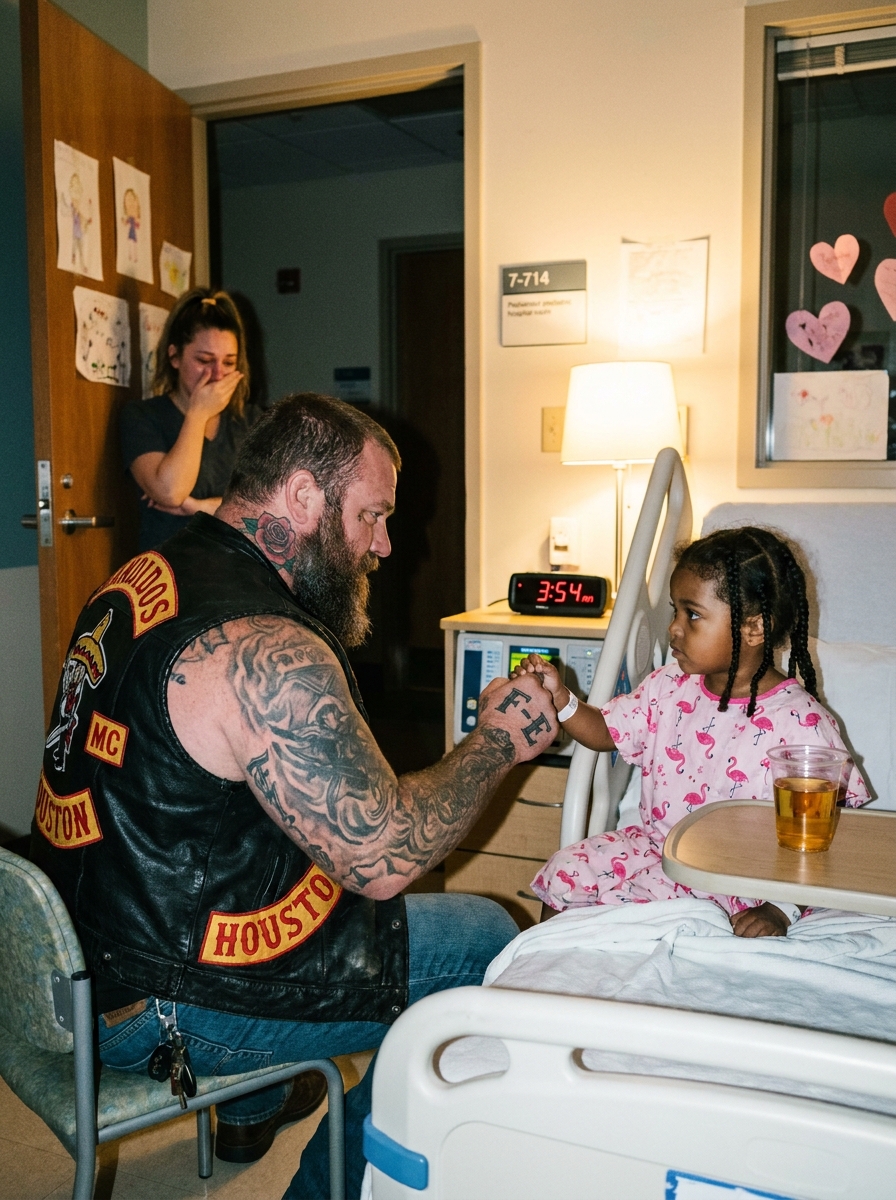
He had walked into Sofia’s room at 3:54 a.m. on the morning of November 13th, 2024.
He had been wearing his Bandidos cut over a black short-sleeve t-shirt that revealed his tattoo sleeves entirely — both forearms, both biceps, the tattoos on the back of his neck, and the small visible curve of the rose-vine tattoo at the open collar of his t-shirt — over dark jeans and worn black motorcycle boots.
He was, physically, exactly the kind of man you would not, under any other circumstances, want suddenly entering your sick four-year-old daughter’s hospital room at 3:54 in the morning.
Sofia did not, by any visible reaction, find him frightening.
She had, when the door opened, turned her face toward him from her position curled up on the far side of her hospital bed against the railing.
She had looked at him for about five seconds.
She had not screamed.
She had not pulled the blanket over her head.
She had said, in her small four-year-old voice, “Are you a nurse?”
Titan had said, in a voice that was deeper and gentler than I had braced myself for, “No, mija. I’m not a nurse. My name is Mr. Titan. I’m a friend of Miss Rosalinda’s. She told me you were having a hard week. I asked if I could come visit you.”
Sofia had said, “You don’t have a needle?”
Titan had said, “No, mija. I don’t have a needle. I am not going to bring any needles into this room. I do not have any needles on me. You can check, if you want.”
Sofia had said, “Okay.”
He had stood in the doorway. He had not moved further into the room.
He had said, “Sofia. May I come sit in the chair by your bed?”
She had said, “Okay.”
He had walked in. Slowly. Deliberately. The way a 290-pound man walks toward a sick four-year-old when he does not want to scare her. He had pulled the small vinyl bedside chair away from the wall. He had sat down. His knees had come up almost to his chest. The chair had creaked under him.
He had said, “Mija. I heard you don’t like needles right now.”
Sofia had said, “I hate needles.”
Titan had said, “Yeah, mija. They are the worst.”
Sofia had said, “You don’t know.”
Titan had been very quiet for about three seconds.
Then he had said, “Sofia. I want to show you something. Is that okay?”
She had said, “Okay.”
He had pulled the right sleeve of his t-shirt up his shoulder, exposing his entire dense black-and-gray tattoo sleeve from wrist to shoulder.
He had said, “Mija. Do you see all these tattoos?”
Sofia had said, “Yeah.”
He had said, “Sweetheart. Each one of these — every single one — was made with a needle. The artist takes a tiny needle and makes the picture by poking your skin. Lots of pokes. Lots of needles. I have so many tattoos that — I have been poked with needles, mija, more than a thousand times in my life. I lost count a long time ago.”
She had blinked.
He had said, very quietly, very deliberately, “And mija. I am still here.”
He had paused.
He had said it again.
“I am still here, sweetheart. I have been poked a thousand times. And I am still right here, sitting in this chair, talking to you. Needles do not break us. Needles are how the medicine gets in. The medicine is how we get to keep being here. You are gonna be poked tomorrow, and the day after, and probably for a few days after that. Some of it is gonna hurt. And you are still gonna be here when it’s done.”
Sofia had not said anything for a long time.
Then she had said, “Mister Titan. Will you stay?”
Titan had said, “Yes, mija. I’ll stay as long as your mama lets me.”
She had turned her body, slowly, away from the railing.
She had held out her right arm — the arm with the IV — toward me.
She had said, “Mama. Get the nurse. I’m ready.”
I want you to understand that my four-year-old daughter had not asked for a nurse in six days.
I had walked into the hallway. I had found Rosalinda. I had brought her back.
Titan had stayed in the chair.
Rosalinda had checked the IV line. She had drawn the standard pre-op blood panel that had been refused for six straight days.
Sofia had flinched. She had not screamed.
She had held Titan’s huge tattooed left hand — specifically, his left index finger, which was about the size of three of her fingers stacked — with her small right hand the entire time.
Titan had said, “Mija. Watch my face. Don’t watch the needle. Tell me about your favorite color.”
Sofia had said, “Pink.”
Titan had said, “Pink. Good choice. Tell me a pink thing.”
Sofia had said, “Flamingos.”
Titan had said, “Flamingos. Yes. I love flamingos.”
Rosalinda had finished the draw at 4:02 a.m.
Sofia had said, “Mister Titan. I did it.”
Titan had said, “Mija. I told you. You’re still here.”
She had nodded.
She had not let go of his finger.
He had, for the next forty-five minutes, sat in the bedside chair and held her small hand while she fell asleep.
He had not left until 5:30 a.m.
He had been back at 9:00 a.m. that same morning, after going home for two hours of sleep and a shower.
He had been at the hospital, sitting in that bedside chair, holding Sofia’s small hand, every single day for the next eleven days — through the surgery, through the four-hour wait in the family lounge with me on November 14th, through the post-operative ICU stay, through the step-down recovery, through the day she was discharged on November 24th, 2024.
He had not, in those eleven days, told me a single thing about himself that I did not figure out later.
I want to tell you what I learned about Titan eleven months later.
Sofia had her one-year post-operative cardiology check at Texas Children’s on October 18th, 2025.
Titan had asked, weeks in advance, if he could come along. He had not, in eleven months, missed a single one of Sofia’s clinical follow-ups.
After the appointment — Sofia’s ejection fraction was strong, the patches were holding, the valve was functioning beautifully, the cardiac team had told us we could move to annual visits — we had gone for lunch at a small taqueria off Bellaire Boulevard called La Macro. Sofia had ordered chicken nuggets, because she is six. Titan had ordered three barbacoa tacos. I had ordered tortilla soup.
Sofia had finished eating quickly. Her cousin Lucia had been waiting at the booth across from us. Sofia had asked if she could go play with Lucia in the small fenced patio behind the restaurant where there was a child-sized table.
I had said yes.
She had run off.
Titan and I had sat in the booth.
I had been wanting to ask him a specific question for eleven months.
I had finally asked it.
I said, “Tomás. The morning you walked into Sofia’s room. You showed her your arm. You told her you had been poked a thousand times. You told her you were still here. I want to ask you a question. You can tell me to mind my business if you want.”
He said, “Marisol. Ask.”
I said, “Tomás. Were you talking about tattoos.”
He sat with the question for a long moment.
Then he set down his fork.
He said, “Marisol. Mostly no.”
He pulled his right sleeve up to the elbow.
He turned his arm so I could see the inner forearm.
I had seen this arm a thousand times in eleven months. I had never, in eleven months, looked at it the way he was about to ask me to look at it.
He said, “Mija. Look closely.”
I leaned in.
He said, “Marisol. Do you see, under the tattoos, the lines in my skin?”
I looked carefully.
The tattoo work was so dense — black-and-gray, layered, intricate religious imagery and Latin script and roses and a small Santo Niño — that I had to look hard.
But I saw them.
There were lines under the tattoos. Thin, slightly raised, paler than the surrounding skin. They were running in patterns that did not match the tattoo design — they were straight where the tattoos curved, they were located where no tattoo line would have been placed, they were the kind of lines that a tattoo artist would never have drawn freehand.
They were scars.
Surgical scars.
He pointed at one — a four-inch line that ran along the inside of his right forearm, almost completely covered by a long stem of inked roses.
He said, “Marisol. That one was a port. They put a chemo port in my forearm when I was nine. The scar is from when they removed it three years later.”
He pointed at another — a small puncture-shaped scar on the inside of his right wrist, completely covered by a small ink rosary.
He said, “That one is from a PICC line they put in when I was six.”
He pointed at his left forearm.
He said, “The scars on this one are mostly central line scars from when I was three and four. I had three open-heart surgeries between birth and age seven, mija. I have a sternal scar that runs the entire length of my chest, from my collarbone to the bottom of my ribs. The roses on my chest — the ones that go from my right collarbone down across my heart? Those are not just roses. They are the cover-up tattoo on the sternal scar from my third surgery. I had the roses done in 2009 to cover the scar. The roses are the scar.”
I sat in the booth at La Macro and I could not, for about thirty seconds, make my mouth work.
He kept going.
He said, “Marisol. I was born in 1984 with tetralogy of Fallot. I had my first open-heart at four months. My second at age three. My third at age seven. I spent — between birth and age twelve — somewhere around three hundred days in the hospital. I had every kind of needle a child can have. IV lines. Central lines. PICCs. Ports. Chemo through the port — I had a complication that required a course of cardiac medication delivered intravenously over several months when I was nine. Blood draws. ABG sticks. Spinal tap once when I was four for a workup. I lost count of needles when I was seven. By the time I was twelve, I had been stuck — and I am not exaggerating, mija, this is from memory and from my mother’s old hospital records — somewhere between eight hundred and nine hundred and fifty times.”
He paused.
He said, “Marisol. When I told your daughter I had been poked a thousand times, I was not lying. I rounded up by maybe fifty. I have been poked, in my life, somewhere between nine hundred and a thousand times. I am still here.”
I said, “Tomás. Why didn’t you tell me.”
He said, “Marisol. Because — because Sofia did not need to hear that her hospital volunteer was a former pediatric cardiac patient. She needed to hear that a tough-looking man was still here after a thousand needles. She did not need to know I was her, twenty-five years ago. That was not her job. That was my job. To carry it, while she only had to carry her own.”
He paused.
He said, “I started getting the tattoos in my early twenties. The first one was the rose-vine over my sternum, in 2009, to cover the surgical scar from my last open-heart. I had been carrying the scar for fourteen years and I had never been able to take my shirt off in public. Not at a pool. Not at a beach. Nowhere. I was twenty-five years old and I had never gone shirtless in front of another adult.”
He said, “The roses changed that. The roses turned the scar into something I had chosen. Something beautiful. After the roses, I started doing the same thing on my arms. Every surgical scar, every port site, every line scar — I tattooed over it. I worked with one artist for ten years. He knew what he was doing. The tattoos are not random. Every single one is a cover-up. Every single one is a scar that I turned into something I wanted on my body.”
He looked at me.
He said, “Marisol. The reason I volunteer at Texas Children’s every Tuesday afternoon and one Saturday a month is not because I am brave. It is because I know — in my body, in my scars, in my memory — what it is to be four years old and lying on a pediatric cardiac ward and looking at the ceiling tiles and being scared. I know what those ceiling tiles look like. I know what the smell of the hand sanitizer dispenser at the door of a pediatric room smells like. I know what the click of a metal IV stand sounds like when the night nurse rolls it down the hallway at 2 a.m. I know all of it. I have not forgotten any of it. I do not want any other four-year-old to have to lie in that bed alone.”
He paused.
He said, “I do not tell the kids any of this. I never will. They do not need to know. They just need a tough-looking man to roll up his sleeve and tell them he has been poked a thousand times and is still here. The truth — the rest of it — is mine. It belongs to me. I carry it so they don’t have to.”
I sat in the booth for a long time without speaking.
Then I said, “Tomás. The knuckles. F-E and Y-A. What does the A stand for.”
He held up his left hand.
He said, “Marisol. Faith and Action. I had the FE knuckles done first, in 2007, when I was twenty-three. I had the YA knuckles done in 2014, the year I joined the Bandidos. The YA is short for Acción. Faith is what got me through the surgeries as a kid. Action is what I owed back.”
He closed his hand into a soft fist.
He said, “Marisol. Your daughter, the morning of November 13th. She gave me my action that day. She held my finger. She showed up. She let the nurse do the draw. She was not afraid. She was four years old and she was the bravest person in the room.”
He paused.
He said, “I had been waiting twenty-five years to be the man in the bedside chair instead of the boy in the bed. Your daughter let me be that man. I owe her, Marisol. Not the other way around.”
I did not say anything.
I just reached across the booth.
I took his huge tattooed hand in mine.
I held it for a long time.
Sofia and Lucia came running back in from the patio.
Sofia climbed into Titan’s lap.
She did not, at six years old, know any of this.
She does not, today at six years and three months, know any of it.
She will, on her sixteenth birthday, when she is old enough to understand it, hear it from him directly. Titan and I have agreed to that.
For now, she calls him Tío Titan.
She has a small framed photograph on her bedside table.
The photograph shows a six-year-old girl with dark hair, sitting on the lap of a 290-pound tattooed biker, both of them laughing, taken on the patio at La Macro on the afternoon of October 18th, 2025.
She kisses the photograph every night before bed.
She does not, yet, know what the tattoos on his arms are.
She just knows that her Tío Titan is still here.
And so is she.
The truth I learned at La Macro on October 18th, 2025, has been with me for thirteen months as I write this. I have been thinking about it almost every day.
There is one detail I have not told you yet that I want to tell you now, because Titan has given me permission and because the detail is the part of the story that I still cannot get past.
After Sofia’s surgery on November 14th, 2024, she had spent two days in the cardiac ICU on the seventh floor.
On the second night — November 15th, around 11:00 p.m. — I had been in the family lounge trying to sleep. The ICU only allowed one parent at the bedside overnight, and we had alternated; Sofia’s father, my ex-husband Roberto, had been with her that night. I had been in the lounge.
Titan had come in at about 11:45 p.m. He had been at the hospital all day. He had brought me a small paper cup of decaf coffee from the cafeteria.
He had sat down next to me on the small vinyl couch.
He had said, “Mija doing okay?”
I had said, “She’s stable. Roberto’s with her.”
He had said, “Marisol. Can I tell you something? It’s small.”
I had said, “Of course.”
He had said, “I came up here at 6:00 this morning before my shift. I sat with her for an hour while you were down at the cafeteria with your sister. The night nurse let me in. I just sat in the chair. She was asleep. I held her hand.”
He had paused.
He had said, “Marisol. While I was sitting there, I — I want to tell you something I have not told another adult in twenty-five years. While she was asleep, with the bandage on her chest from the sternotomy, with the chest tubes still draining, with the heart monitor going — for one second I — I forgot it was her. For one second I thought it was me. I thought I was four years old again on the cardiac ward at Texas Children’s, after my second surgery in 1987. I thought I was looking at myself.”
He had paused.
He had said, “Marisol. It was the strangest hour of my life. I sat there for the rest of the hour and I did not know whether I was the man holding the child’s hand or the child being held. I — I think I was both. I think for that one hour I got to be both. The child I was, and the man I wished had been there. At the same time.”
He had wiped his eyes.
He had said, “Marisol. I am sorry. I should not have told you this. It is not — it is not my hour to claim. It was hers.”
I had said, “Tomás. It was both of yours.”
He had nodded.
He had drunk his coffee.
He had not said anything else that night.
He had been there at 6:00 a.m. the next morning. And the morning after that. And every morning until she was discharged.
I want to tell you about the rose-vine tattoo on Titan’s chest.
He showed it to me, in full, for the first time on a Saturday afternoon in early November of 2025 — a year after Sofia’s surgery — when he and I and Sofia had taken a small day trip to Galveston. He had been in the surf with Sofia. He had taken his shirt off for the first time in front of me.
The rose-vine tattoo runs from his right collarbone diagonally across his sternum and ends just below his left rib cage. It is about fourteen inches long. It is dense, intricate, deep black-and-gray, with delicate red highlights on the rose petals.
Underneath the rose-vine — visible only because I knew, by then, what to look for — is a single long, raised, slightly silvered surgical scar.
The scar runs the entire length of the rose-vine. It is the sternotomy scar from his third open-heart surgery, performed at Texas Children’s Hospital on March 18th, 1991, when he was seven years old.
The roses are not random.
The roses follow the scar exactly.
They begin where the scar begins, at the top of his sternum.
They end where the scar ends, at the bottom of his ribs.
Every single rose petal is positioned over a single staple-mark or suture-mark from the surgery.
Each thorn of the vine is positioned over a single point where, in 1991, a chest tube had been inserted.
The artist who did the work in 2009 had spent four sessions, fourteen hours total, carefully mapping the existing scar before laying down a single line of ink.
Titan had told me, at La Macro, “Marisol. I had to find an artist who would treat the scar as the line work. Not cover it. Not erase it. Use it. The scar is still under there. The roses are on top. They are the same line. You have to look hard to see it.”
I had asked him whether he was glad he had done it.
He had said, “Marisol. I was twenty-five years old when I got the rose-vine. I am forty-one now. I have looked in the mirror every morning for sixteen years and I have seen roses where I used to see the worst day of my mother’s life. I am glad.”
He had paused.
He had said, “Marisol. Your daughter is going to have a sternotomy scar for the rest of her life. It will fade. It will get smaller. It will not go away. When she is sixteen, if she ever — if she ever wants to do for herself what I did for myself — I want you to bring her to me. I will introduce her to the artist. He is still working. He is still good. He will know what to do.”
I had said, “Tomás. Are you — are you offering to pay for it.”
He had said, “Marisol. That is between her and me when she is sixteen. We do not need to talk about it now. I am just telling you that the offer is there. For when she is ready. If she wants it.”
I had not been able to speak.
I had only nodded.
He had nodded back.
We had not talked about it again.
I will, on Sofia’s sixteenth birthday in August of 2036, remind both of them about the conversation.
She will, by then, be old enough to choose for herself.
Whatever she chooses will be hers.
Sofia is six.
She is in first grade.
She is healthy.
She has her annual cardiology check coming up in October of 2026.
Titan still volunteers at Texas Children’s every Tuesday afternoon and one Saturday morning a month.
He has, by his volunteer coordinator’s count, sat with eighty-seven different children in the pediatric cardiac unit since November of 2019.
He has rolled up his right sleeve for, by his own count, sixty-four of them.
He has told sixty-four scared children that he has been poked a thousand times and is still here.
He has not, in any of those sixty-four conversations, told a single child that the tattoos are scars.
He carries it.
They do not have to.
I will tell you the smallest version of this story, in case you skipped to the end.
A 290-pound tattooed Bandido named Titan walked into my four-year-old’s pediatric cardiac room at 3:54 a.m. on the morning before her open-heart surgery. She had been refusing every needle for six days.
He pulled up his sleeve. He showed her his tattoos. He told her each one was a needle. He told her he had been poked a thousand times. He told her he was still here.
She held his finger. She let the nurse do the draw. She fell asleep.
She had her surgery the next morning.
She is okay. She is six. She is in first grade. She kisses a framed photograph of him every night before bed.
The truth — that the tattoos are not just tattoos, that the tattoos are scars he turned into roses — I learned at a taqueria off Bellaire Boulevard eleven months later.
He carries the truth.
The kids carry only what a four-year-old should have to carry.
That is the deal.
That is the entire deal.
He is still here.
So is she.
If this story moved you — follow the page. There are more men out there with rose vines tattooed over fourteen-inch sternotomy scars. More four-year-olds who let go of the metal railing because somebody who looked rougher than the world told them they were going to be okay. There are more stories the world doesn’t see — and I will keep telling them as long as someone keeps reading.