The Woman Who Held the World
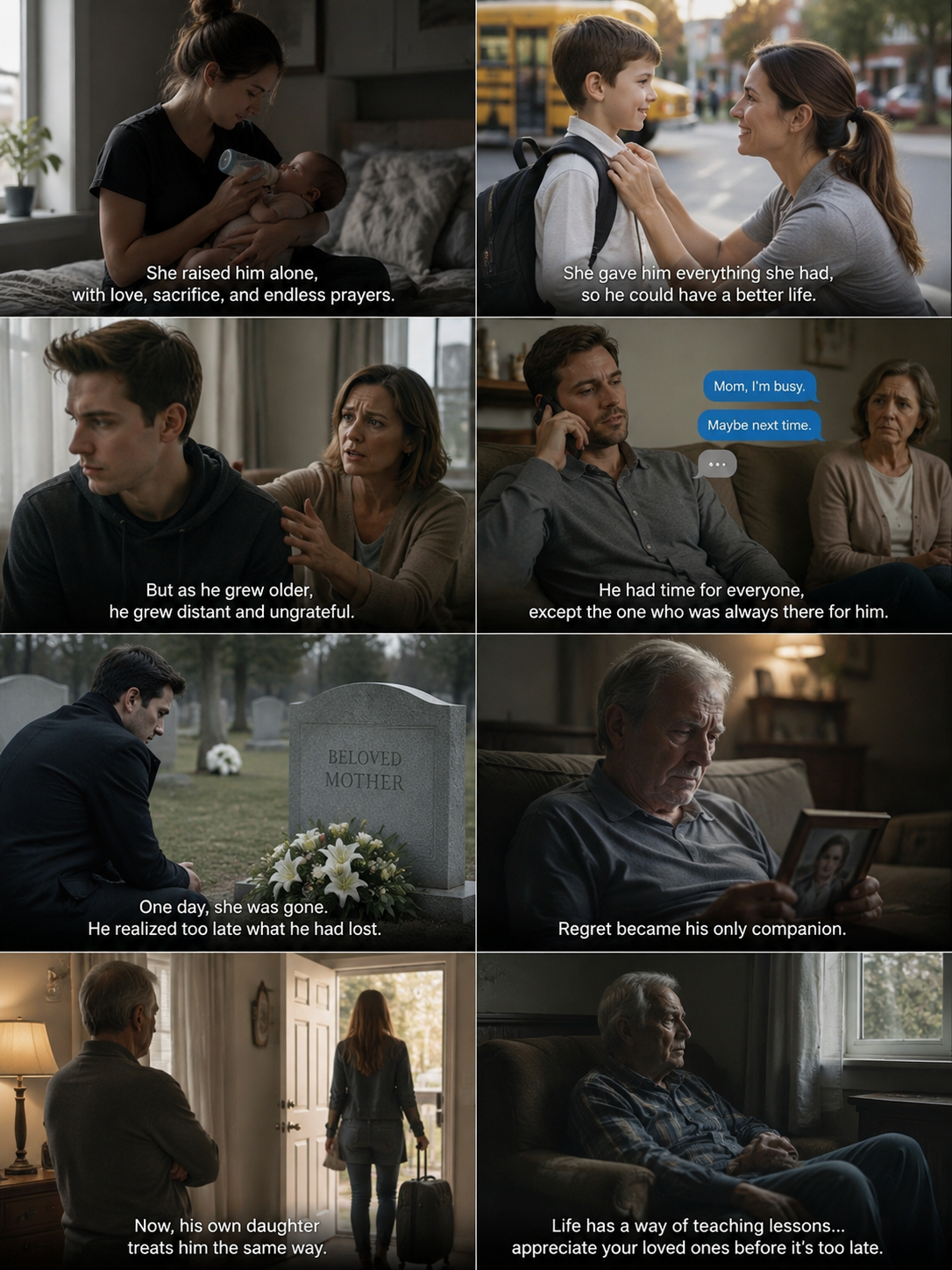
She was twenty-three and terrified when she brought little Marcus home from the hospital. The apartment smelled of fresh paint she had applied herself over the weekend, trying to make something small feel like enough. His father, Thomas, had left four months before. “I’m not ready for this,” he had said, as if fatherhood were a meeting he could reschedule. Elena had stood in the doorway, watching his headlights disappear down the road, and made a quiet, furious promise to herself and to the child moving inside her: We will be enough.
And they were.
She worked the breakfast shift at a diner and the evening shift at a laundromat. She studied accounting in the hours between, her textbooks propped open on the kitchen counter while baby Marcus slept in a bouncy seat nearby. She sang to him in Spanish — songs her own mother had sung in a small village far away — and in English, so he would never feel like a stranger in either world. She never let him see her cry. That was her rule. She cried in the shower, where the sound would be swallowed by running water.
By the time Marcus was five, she had her bookkeeping certificate. By the time he was eight, she had her own small office. By the time he was twelve, they had moved out of the apartment and into a house — small, yes, but with a yard and a tree and a bedroom that was entirely his.
She came to every school play. Every parent-teacher conference. Every baseball game, even the cold Tuesday morning ones when she had worked until midnight the night before. She sat in the bleachers and cheered louder than anyone. She was embarrassing. He loved her for it.
“You are my whole world, mijo,” she told him once. He was fourteen and squirmed at the tenderness. “Mom. Stop.” She laughed. She always laughed.
The Man Who Got Busy
Marcus was twenty-seven when he landed his first major contract. He called Elena from the parking lot of his firm’s office, breathless and giddy. She cried. He could hear her through the phone — those tears she had never let him see when he was small. He promised to celebrate with her that weekend.
He cancelled on Friday. A work dinner. “Next weekend, Mom, I promise.”
But next weekend was a conference. Then a project deadline. Then a trip with Claire, who became his girlfriend, then his fiancée, then his wife. Claire was educated, ambitious, and beautiful in an effortless way that made people at parties seem smaller by comparison. Elena liked Claire, but sensed from the beginning that Claire’s world was a gravity that would pull Marcus steadily toward the horizon.
Elena still called every Sunday morning at nine o’clock. Without fail. In the early years Marcus answered every time. Then every other time. Then he started letting it ring through to voicemail when he was busy, telling himself he would call back. Sometimes he did. More often, he did not.
“Of course,” Claire agreed.
Elena never complained. That was the thing that would haunt him later. She never once said you never call or I miss you with any accusation in her voice. She simply called. She left messages — cheerful messages, little updates about the neighbors, questions about whether he was eating well. She mailed him homemade tamales at Christmas in a box with careful instructions for reheating. She sent him articles she thought he would find interesting, little forwards with a note at the bottom: Thought of you, mi amor.
He would read them later. He always meant to respond.
They saw each other at Thanksgiving, usually. Sometimes Christmas. When their daughter Sophie was born — the most exquisite creature Marcus had ever seen — Elena came for two weeks and cooked and cleaned and held the baby while they slept. She left a handwritten note on the kitchen table when she went back home: This is the most beautiful thing I have ever seen. Second to you. I am so proud of you, mijo.
Marcus found the note three days later under a takeout menu. He meant to frame it.
The Calls That Went to Voicemail
Elena got sick when Marcus was thirty-eight. She told no one at first — not him, not her sister Rosa, not her friends from the church. She sat with the diagnosis alone, turning it over like a stone in her hands, learning its weight. Pancreatic cancer. Stage three.
She started telling Rosa slowly. Then her church friends. Then the outer edges of her world — everyone, it seemed, except Marcus. Later, Rosa would tell him why.
“She didn’t want to worry you,” Rosa said, her voice flat and careful. “She said you were in the middle of a big project.”
He had been. He was always in the middle of something.
Elena went through her first round of chemotherapy with Rosa by her side. She lost twenty pounds. She lost her hair. She bought a beautiful silk scarf — teal, her favorite color — and wore it with a dignity that made people in the grocery store smile at her. She kept calling Marcus every Sunday at nine. Her voice was thinner, but she never said why.
He noticed — he did notice. “You sound tired, Mom.”
“I am always tired at my age,” she said, and laughed, and asked how Sophie was doing in school.
He told her about Sophie’s finger paintings and a funny thing she had said at breakfast and Claire’s new promotion at work. He talked for forty minutes. She listened, as she always had, completely.
He hung up and forgot to ask how she was doing.
Three months later, Rosa called him. Not Elena. Rosa.
“Marcus.” A long pause. “You need to come home.”
The Room That Smelled of Candles
He drove six hours through the night. He kept telling himself: She’ll be fine. She’s tough. She’s Elena. As if the sheer force of her character could negotiate with cancer. He rehearsed what he would say when he walked through the door. He had so many apologies ready — explanations, justifications, promises — all the words he had saved up and never said.
Elena died at 4:17 in the morning. Two hours before he arrived.
The hospice nurse met him at the door. Rosa was inside at the kitchen table with a cup of cold tea, her eyes red and dry as if she had run out of tears hours ago. He walked into his mother’s bedroom. Someone had lit candles — teal ones, her favorite color. The room smelled of lavender and wax and something else he could not name. She looked smaller than he remembered. She looked peaceful in a way that struck him as unbearably unfair — she should have been angry. She should have left him something to fight against.
He sat beside the bed and held her hand, still warm.
He talked to her for two hours. He said everything — the apologies he had rehearsed and new ones that came from somewhere deeper, from a part of himself he hadn’t visited in years. He told her about the baseball games and the bleachers, the tamales, the note he had found under the takeout menu and never framed. He told her he was sorry. He told her she was his whole world.
He cried in a way he hadn’t cried since he was a boy — ugly, heaving, without any dignity at all.
The Mirror Cracks
Sophie was twelve when Claire sat Marcus down at the kitchen table.
“I’ve tried,” Claire said. She spoke with the calm of someone who had rehearsed this many times. “I have genuinely tried. But you are not here, Marcus. You’ve never really been here.”
He protested. He was home every evening. He provided. He worked himself raw to give them everything they needed. “That’s not fair,” he said.
She looked at him for a long time. “Your mother raised you alone. And she was more present than you have ever been.”
She moved out on a Tuesday. Sophie went with her, because at fifteen Sophie barely knew her father — he was a man who appeared at dinners and birthday parties, who drove her to school occasionally, who sat across from her at the dinner table scrolling through his phone.
Marcus got the house. He got the big silent rooms. He got Sunday mornings with nothing in them.
The irony did not hit him yet.
Nine O’Clock Sunday
Sophie was twenty-four and living in a city three time zones away. She had a graduate degree and a career she never fully explained and a life Marcus knew only through social media photos he was not always sure were meant for him to see.
He called her every Sunday morning at nine o’clock.
Sometimes she answered. More often, the phone rang four times and fell to voicemail — her voice bright and professional: Hi, you’ve reached Sophie! Leave a message and I’ll get back to you soon.
He left messages. He told her about the neighbors and the rain and something he had seen on the news. He asked if she was eating well. He forwarded her articles he thought she’d find interesting. He signed the texts: Love, Dad.
One Sunday she didn’t answer, and he stood in his kitchen — the same kitchen, the same November light coming through the window, the same hollow quiet — and he listened to her voicemail greeting play to its end. And something cracked open in his chest like a fault line giving way after decades of pressure.
He thought of a voice, thinner than he remembered, saying: I am always tired at my age.
He thought of a note under a takeout menu that he never framed.
He thought of a room that smelled of candles, and two warm hands that would never be warm again.
He set his phone down on the counter.
He sat on the kitchen floor — this man, this fifty-one-year-old architect with a successful firm and a beautiful house and an emptiness in him wide enough to echo — and he understood, at last, with the kind of clarity that only arrives too late, exactly what he had done.
And exactly what had been given back to him in return.
Not as punishment. Not as revenge. As echo. A perfect, faithful echo of everything he had withheld.
The Note
Marcus found it that spring, cleaning out the last of his mother’s boxes that Rosa had kept in storage for years. He had procrastinated opening them. He did not have a good reason for this; perhaps the good reason was simply that he was afraid.
The letter was at the bottom of the third box, folded once, in Elena’s handwriting on a piece of green stationery. At the top, in her careful cursive: For Marcus — when the time is right.
My love,
If you are reading this, then I am gone, and there are things I want you to know. I was never angry at you. Not for the missed calls, not for the missed visits, not for any of it. You were building your life, and I was so proud of every brick of it.
But I want you to know this one thing, and I want you to keep it close:
The greatest thing I ever did was love you without condition. And the greatest gift I ever gave you was not the house or the education or the sacrifices. It was the model. Every single day, I showed you what love looks like when it shows up.
Now it is your turn to show someone else.
It is not too late. It is never too late to pick up the phone. It is never too late to get in the car and drive. It is never too late to sit across from someone you love and be fully, completely present.
Do not wait for a funeral, mijo.
Call her. Go to her. Let her know.
All my love, forever and without condition,
Mamá
Marcus read the letter three times, sitting on the floor of Rosa’s storage room with dust on his hands and tears running down his face and not caring about either.
Then he took out his phone and called Sophie.
She answered on the third ring.
“Dad?” She sounded surprised. Cautious. Like someone opening a door they had kept closed for a long time.
“Hey, mija.” His voice broke. He let it. “I just wanted to tell you that I love you. And I’m sorry. And I know I haven’t shown up the way I should have.” He stopped. Started again. “I’m learning. I’m late, I know. But I’m learning.”
A long pause. He could hear her breathing across three time zones.
“Okay,” she said. Not it’s fine. Not don’t worry about it. Just: okay. An open door. A beginning. Small as a candle flame, but warm.
It was enough.
It was, at last, a start.
What This Story Teaches Us
Love is a verb, not a feeling. It must be performed, repeated, and shown up for. Keeping love silently inside yourself while the person waits by the phone is not love — it is a debt.
Your children do not do what you tell them — they do what you do. The parent you are to your mother or father will one day be mirrored back to you by your own child. The pattern you choose today is the world you will live in tomorrow.
A parent’s silence is not permission. Elena never complained — not because she didn’t hurt, but because she loved him too much to make him feel guilty. Do not mistake someone’s grace for an absence of need.
No career achievement will sit with you at the end. The promotions, the projects, the conferences — none of them will hold your hand when you are old and afraid. The people will. Or they won’t, because you chose the meetings instead.
There is a deadline more real than any work deadline. It is the last day someone who loves you is still alive to receive your love in return. You do not know when that day is. Act accordingly.
“Do not wait for a funeral to say the things that needed to be said at a breakfast table.”