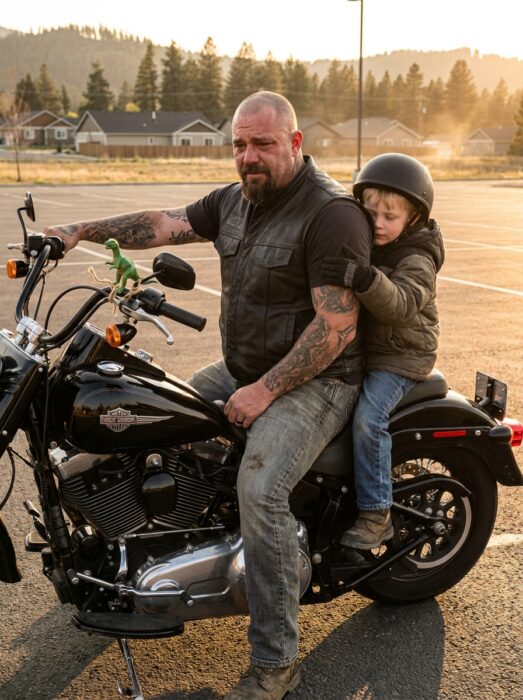
I knew Hawk before I knew his name.
Most of us on Silver Pine Road did.
That is how neighborhoods work. We know patterns before people.
We knew the Harley left before sunrise.
We knew the garage light stayed on late.
We knew he mowed his lawn in straight lines every Wednesday and never talked over the fence unless someone spoke first.
We knew he had a wife who carried groceries alone even when he was home, not because he was lazy, but because he sometimes stood in the garage with both hands on the workbench like he was holding himself in place.
We knew he had a little boy who adored him.
What we did not know was how hard the man was fighting to stay gentle.
Hawk came home from his last deployment with hearing damage, two scars in his thigh, one in his shoulder, and a nervous system that no longer trusted ordinary life. The doctors called it PTSD. Hawk called it “bad wiring.” Emily called it “the thing we work around.”
There were rules in their house.
Good rules.
Loving rules.
Announce before entering the garage.
Say his name before touching him.
Never wake him by shaking.
Keep fireworks away from the backyard.
Let him sit facing the door at restaurants.
No surprise parties.
No hands from behind.
The last rule hurt Emily the most.
Before the war changed him, Hawk had been the kind of man who pulled her into the kitchen while coffee brewed. He used to wrap both arms around her while she cooked and rest his chin on her shoulder. She used to hug him from behind while he fixed the sink, just to annoy him.
After he came home, she tried it once.
Only once.
He spun so fast the wrench hit the floor. His eyes went empty. His hands came up like he was somewhere else, with someone else, in another country under another sky.
He did not hurt her.
He would have rather cut off his own hand.
But the look on his face scared them both.
He slept in the garage that night because he was ashamed.
Emily sat outside the door until 2:00 a.m. and said through the wood, “I know it wasn’t you.”
He answered, “That’s the problem.”
Noah was two then.
Too young to understand why Daddy sometimes slept sitting up. Too young to understand why Mommy said, “Let Daddy see you first,” before he ran into a room. Too young to understand why thunder made the house go still.
But children learn the weather of a family.
Noah learned to announce himself.
“Daddy, I’m coming in.”
“Daddy, I’m behind you.”
“Daddy, my truck is loud.”
Hawk hated that.
Not the boy.
Never the boy.
He hated that his five-year-old son had learned to move around his father’s wounds like furniture in the dark.
The Harley became Hawk’s one steady thing.
It was not about freedom.
He hated when people said that.
Freedom sounded too clean.
The bike was rhythm.
Check oil.
Check tires.
Wipe tank.
Start engine.
Listen.
Throttle.
Clutch.
Brake.
Repeat.
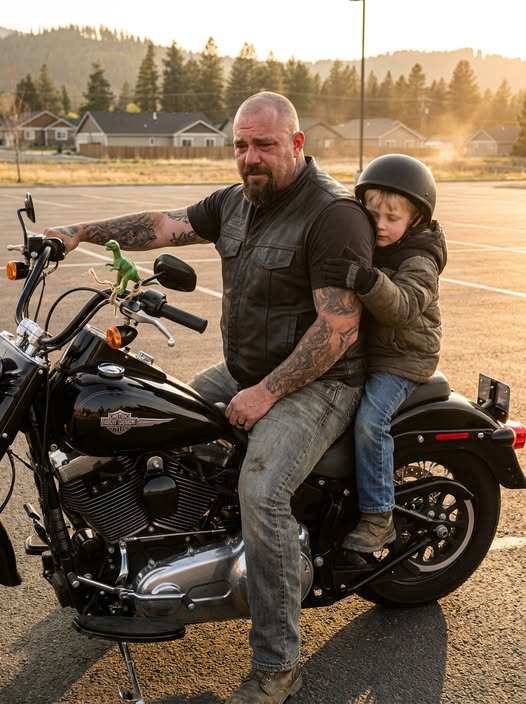
The garage smelled like leather, gasoline, old coffee, and metal polish. Tools hung in order. Rags folded on the left shelf. Gloves on the right. Noah’s plastic dinosaur on the handlebar, always facing forward.
That dinosaur was the first seed.
Noah had put it there after asking if motorcycles got scared.
Hawk said, “Machines don’t get scared.”
Noah said, “Then he can be brave for both of you.”
Hawk had looked at Emily then.
Neither of them laughed.
The second seed was the old Army watch on Hawk’s workbench.
Stopped at 2:17.
He never wore it.
Never fixed it.
Never moved it.
Noah once asked why it did not tick.
Hawk said, “Some things stop and still stay with you.”
Noah accepted that because children sometimes understand poetry when adults only hear damage.
The third seed came the week before the first ride, when Noah climbed onto the stationary Harley in the garage and leaned forward against Hawk’s back.
Hawk had been tightening the mirror.
He froze.
Emily, in the doorway, went pale.
But Hawk did not jerk away.
Noah’s arms were not around him yet. Just his small chest resting against the back of the vest, his helmetless head between Hawk’s shoulder blades.
“Daddy,” he said, “your back sounds quiet.”
Hawk swallowed hard.
“What does that mean?”
Noah shrugged.
“It means quiet.”
Hawk did not understand.
Not yet.
The first ride happened in a church parking lot.
Not on a road.
Not even a side street.
Hawk had made that clear to everyone, including the sky.
He chose the empty lot across from their house because it was flat, wide, and had no cars after Saturday evening service setup was done. He walked it twice before starting the Harley. Checked for gravel. Broken glass. Oil spots. Anything that could become a story ending badly.
Emily watched from the front porch at first.
Then the kitchen window.
Then the porch again.
She could not stay still.
Noah wore jeans, sneakers, a padded jacket, gloves that were too big, and the black helmet that made him look like a determined mushroom. Hawk adjusted the chin strap four times.
“Too tight?” Hawk asked.
“No.”
“Can you breathe?”
“Yes.”
“Can you hear me?”
Noah nodded.
“Words.”
“Yes, sir.”
Hawk pointed to the bike.
“You hold my belt or my vest. No waving. No leaning. No superhero moves.”
“No superhero moves,” Noah repeated.
“You get scared, tap me three times.”
Noah tapped his father’s arm three times.
Hawk flinched.
Not badly.
But enough.
Emily saw it.
Hawk closed his eyes for half a second.
Noah looked worried.
“Sorry.”
Hawk crouched in front of him. Big tattooed biker on one knee, face level with a boy whose helmet nearly swallowed him.
“You didn’t do wrong,” Hawk said. “My body’s just dumb sometimes.”
Noah considered that.
“Can bodies learn?”
Hawk’s jaw tightened.
“Trying.”
That was when Emily almost told him to stop.
Not because she didn’t trust him.
Because she did.
She trusted him so much it hurt to watch him walk toward something that might break him.
Hawk started the Harley.
The sound filled the evening.
Not loud like showing off.
Low.
Controlled.
The dinosaur on the handlebar vibrated so hard its plastic head nodded.
Noah laughed.
Hawk looked back.
“Still want to?”
“Yes.”
He lifted Noah onto the passenger seat.
The boy’s legs barely bent around the bike. His boots stuck out awkwardly. The helmet bobbed.
Then Noah wrapped his arms around Hawk’s waist.
Emily’s breath caught.
Hawk’s hands tightened on the grips.
For one second, I swear even the Harley seemed to wait.
Nothing happened.
No jerk.
No sharp inhale.
No twist of panic through his shoulders.
No soldier taking over the father.
Hawk just sat there.
Noah pressed his helmet into the leather vest.
“You ready?” Hawk asked.
“Yes.”
The bike moved.
Slow.
Ten miles an hour.
Maybe less.
It rolled across the empty parking lot, turned wide near the basketball hoop, followed the painted lines, and came back around.
One lap.
Then another because Hawk forgot he had said one.
Emily was crying by then.
The kind of crying that makes no sound because the body knows the moment is too fragile.
At the third lap, Hawk stopped near the curb and killed the engine.
The sudden silence felt enormous.
Noah did not move.
Hawk turned his head.
“Ride’s over, bud.”
Noah’s arms stayed tight around his stomach.
“You good?”
Noah nodded against his back.
“Then why ain’t you getting off?”
The boy’s answer came muffled through helmet padding and leather.
“Because I can hear your heart.”
Hawk went completely still.
Noah continued.
“Like when you hold me while I sleep.”
That was the false climax.
Everyone thought the miracle was that the boy got his first ride.
It wasn’t.
The miracle was that a man who had been untouchable for three years had just discovered the only embrace his body did not mistake for danger.
Later, Hawk tried to explain it badly.
That was his way.
Men like him do not enjoy being understood too quickly. It makes them feel exposed.
That night, after Noah fell asleep with his helmet beside the bed like a trophy, Emily found Hawk in the garage.
The Harley was still warm.
The engine ticked softly as it cooled.
Hawk sat on an overturned milk crate, elbows on knees, staring at the stopped Army watch on the workbench.
Emily stood by the door.
“Hawk?”
He did not jump.
She had said his name first.
“Yeah.”
“Can I come in?”
“Yeah.”
She walked slowly, stopping a few feet away.
He looked tired. Not physically. Deeper.
“I saw you,” she said.
His jaw moved.
“Yeah.”
“You didn’t flinch.”
“No.”
“Why?”
He rubbed both hands over his face.
“I don’t know.”
Emily waited.
He hated that she knew how to wait now.
He looked at the Harley.
“When somebody touches me and I don’t see it coming, my body goes back.”
“To the war?”
He nodded once.
“Hands mean something else there. Grabbing. Pulling. Dragging. Searching. Trying to get you down. Trying to get you out. Trying to keep pressure on wounds. Trying to hold a man together while everything’s coming apart.”
His voice got rough.
“I know this ain’t there. I know you ain’t them. I know Noah ain’t anything but Noah. But my body don’t ask me.”
Emily swallowed.
“And on the bike?”
Hawk looked at the passenger seat.
“He’s behind me, but I know why. I put him there. I expect the weight. I can feel the engine, the seat, the road. His hands ain’t surprising me. They’re part of the ride.”
He paused.
“No. That ain’t all.”
Emily took one careful step closer.
Hawk did not move away.
“When he leans on my back,” Hawk said, “I can’t see his hands.”
Emily frowned softly.
“I just feel the weight of him.”
His eyes went wet.
“Small. Warm. Trusting me.”
That was the twist.
The thing that made touch safe was not courage.
It was responsibility.
When Noah hugged him from the back of the Harley, Hawk did not feel trapped.
He felt needed.
He did not see hands reaching for him.
He felt his child resting against him, believing without question that Daddy would stay upright, steer straight, and bring him home.
Emily covered her mouth.
Because she understood then why she was crying at the window.
For three years, she had watched war stand between her husband and every ordinary comfort.
A hand on his shoulder.
A hug in the kitchen.
Her fingers across his back while passing in the hallway.
All of it had become dangerous by accident.
But their son, sitting behind him on a motorcycle at ten miles an hour, had found a door nobody knew was there.
Hawk looked ashamed.
“I’m sorry,” he said.
Emily blinked. “For what?”
“For him being able to do what you can’t.”
That broke her.
Not because it was cruel.
Because it was exactly what he feared.
She knelt in front of him.
Not touching.
Just close.
“Hawk,” she said, “I’m not jealous of our son.”
He looked at her.
“I’m grateful.”
He stared at her like that sentence hurt worse than anger would have.
Emily smiled through tears.
“I got to see someone hold you,” she whispered. “That’s enough for tonight.”
After that first ride, Noah asked every day.
“Can we do heart ride?”
That was what he called it.
Not Harley ride.
Not motorcycle ride.
Heart ride.
Hawk said no most days.
Not because he didn’t want to.
Because part of healing is not turning one good thing into a demand.
But on Saturdays, if weather allowed, they went to the church parking lot.
Helmet.
Gloves.
Rules.
Three taps if scared.
No superhero moves.
Ten miles an hour.
Sometimes fifteen, which Noah considered reckless and exciting.
Emily watched from the window at first.
Then the porch.
Then the edge of the parking lot.
Each time, she saw the same thing.
Noah’s arms around Hawk’s waist.
Hawk’s shoulders loose.
The Harley moving slow under a wide Idaho sky.
The dinosaur co-pilot bobbing on the handlebar.
The stopped Army watch stayed on the workbench.
That began to change too.
One evening, Noah carried it into the kitchen.
Emily froze.
Hawk was washing dishes.
His back was turned.
“Daddy,” Noah said, “your dead clock is dusty.”
Hawk went still.
Emily almost reached for the watch, then stopped.
Hawk turned slowly.
He saw it in Noah’s hands.
The old Army watch.
Stopped at 2:17.
His face went pale, but he did not snap. Did not yell. Did not flinch.
He dried his hands.
“Yeah,” he said. “It is.”
“Why is it dead?”
Hawk looked at Emily.
Then at Noah.
“Because it stopped on a bad day.”
Noah frowned.
“Can we make it not dead?”
Hawk took a breath.
For years, that watch had been less an object than a locked room. Emily knew only pieces. A convoy. An explosion. A medic. A friend named Ramirez who did not come home. The time stopped because Hawk’s watch cracked during the blast and froze at 2:17.
He had kept it broken because some part of him believed fixing it would be betrayal.
Noah held it out.
“Maybe it wants to tick.”
That was the second twist.
The boy who found his father’s heartbeat on the Harley had also found the one object in the house that still belonged to the war.
Hawk did not answer for a long time.
Then he said, “Maybe.”
The next day, he took the watch to a repair shop downtown.
The old man behind the counter said he could fix it.
Hawk almost took it back.
Then Noah, standing beside him in his oversized helmet because he had insisted on wearing it into town, said, “Ticking is okay.”
So Hawk left the watch.
When they picked it up two weeks later, the second hand moved again.
Tiny.
Steady.
Alive.
Hawk sat in his truck for ten minutes afterward with the watch in his palm.
Noah sat beside him eating fries.
Finally, Hawk whispered, “I don’t know if I’m allowed to let it move.”
Noah dipped a fry in ketchup.
“Time does that.”
Hawk laughed once.
It cracked in the middle.
Then he cried.
Noah did not panic.
He reached across the truck bench and put one small hand on his father’s sleeve.
Not behind him.
Not sudden.
Where Hawk could see it.
“Can I touch?” Noah asked.
Hawk looked at the hand.
Then at his son.
“Yeah.”
Noah patted his arm twice.
Clumsy.
Gentle.
A new rule.
A new map.
Emily noticed the changes slowly after that.
Hawk still flinched sometimes.
A slammed door could still take him away.
Fireworks still meant headphones, lights on, and the family in the basement watching cartoons too loud.
Nightmares still came.
But the world had one more safe place in it.
Then another.
One night, Emily stood beside him in the garage while he polished the tank.
“Hawk?”
“Yeah.”
“Can I try something?”
He set the rag down.
Fear moved across his face, but he stayed.
“What?”
“Not from behind.”
He nodded.
She stepped in front of him first.
Where he could see her.
Then she touched the side of his vest with two fingers.
He breathed in sharply.
But he did not step away.
Emily froze.
He covered her hand with his.
Not tightly.
Just enough.
They stood like that for maybe five seconds.
Then ten.
Noah walked into the doorway wearing dinosaur pajamas.
He looked at them.
Then at the Harley.
“Is this a grown-up heart ride?”
Hawk laughed for real.
Emily did too.
And the garage, which had once been where Hawk hid from touch, became the place where touch learned how to ask permission.
By spring, the church parking lot rides had become a ritual.
Saturday evenings.
Noah in his oversized helmet.
Hawk in his black leather vest.
Emily with coffee on the curb.
The Harley rolling slow circles under the cottonwood trees.
Sometimes the old men from the diner watched from their pickup trucks. Veterans, mostly. Men who knew that not all wounds bled and not all victories looked like parades.
One of them, a Black American Marine veteran named Otis, walked over after a ride and looked at Hawk’s bike.
“Good machine,” he said.
Hawk nodded.
“Yeah.”
Otis looked at Noah, who was telling the plastic dinosaur that it had done a good job.
“Good passenger too.”
Hawk’s mouth twitched.
“Best one I got.”
Otis tapped two fingers against his own chest.
“Sometimes they bring us back without knowing where we went.”
Hawk looked at him.
Otis did not wait for an answer.
He just walked back to his truck.
That line stayed.
Sometimes they bring us back without knowing where we went.
Hawk wrote it on a scrap of cardboard and taped it above the workbench.
Under it, he hung the repaired Army watch.
Still ticking.
Beside it, Noah taped a drawing.
Three stick figures.
A motorcycle.
A dinosaur.
A giant red heart drawn on the back of the biker’s vest.
Emily stared at that drawing for a long time.
“Is that your dad’s heart?” she asked.
Noah shook his head.
“That’s where I hear it.”
By summer, Hawk let Noah ride around the block.
Ten miles an hour.
Then twelve.
Never faster than a bicycle could chase.
Emily walked the sidewalk beside them the first time, which made Hawk raise an eyebrow.
“You planning to outrun the Harley?”
“I’m planning to be a mother.”
“Fair.”
At the corner, Noah tapped Hawk three times.
Hawk stopped immediately.
“You scared?”
Noah shook his helmet.
“Mommy is too slow.”
Emily laughed so hard she had to sit on someone’s retaining wall.
That became another family story.
They needed more of those.
Stories that did not start with deployment or diagnosis.
Stories that belonged to the after.
On Noah’s sixth birthday, Hawk took him for the longest ride yet.
Still not far.
Just from Silver Pine Road to the lake overlook, three miles through quiet streets and one empty access road.
Emily followed in the truck.
Not because she didn’t trust Hawk.
Because she wanted to see it.
The Harley rolled under the evening sky, black and chrome, dinosaur bobbing on the handlebar, father and son moving as one small shape through the gold light.
At the overlook, Hawk killed the engine.
The lake spread below them, blue and silver, mountains standing dark beyond the water.
Noah did not get off right away.
He kept his arms around Hawk’s waist, helmet pressed to the leather vest.
Hawk looked down at those tiny gloved hands.
Still small.
Not forever.
But now.
“You hear it?” Hawk asked.
Noah nodded.
“Boom-boom,” he said.
Hawk put one hand over his son’s hands.
The old panic did not come.
Only the weight.
Only the trust.
Only the sound of his own heart, still here, still working, still carrying both of them.
Emily stood a few feet away, crying quietly in the wind.
Hawk looked at her.
Then, slowly, he held out his other hand.
She stepped closer.
Where he could see her.
And took it.
For a long moment, nobody moved.
The Harley ticked as it cooled.
The lake shone below.
The little plastic dinosaur faced the road home.
And for once, Hawk did not brace for impact.
He just held on.
Follow the page for more stories about the people you almost judged before you knew what they were fighting to survive.