I want to tell you about the diner.
The diner was called Loretta’s Family Diner. It was a small twenty-four-seat diner on Tilghman Street in Allentown, Pennsylvania. It had been owned and operated by a woman named Loretta Strakosch from 1971 until her retirement and the diner’s closure in 2018. Loretta had hired my mother in November of 1997, when my mother had been twenty-five years old, three years after I was born, and one year before my father left. My mother had worked the Thursday-through-Sunday lunch and dinner shift at Loretta’s continuously for the next six years — from November of 1997 until her death in October of 2003.
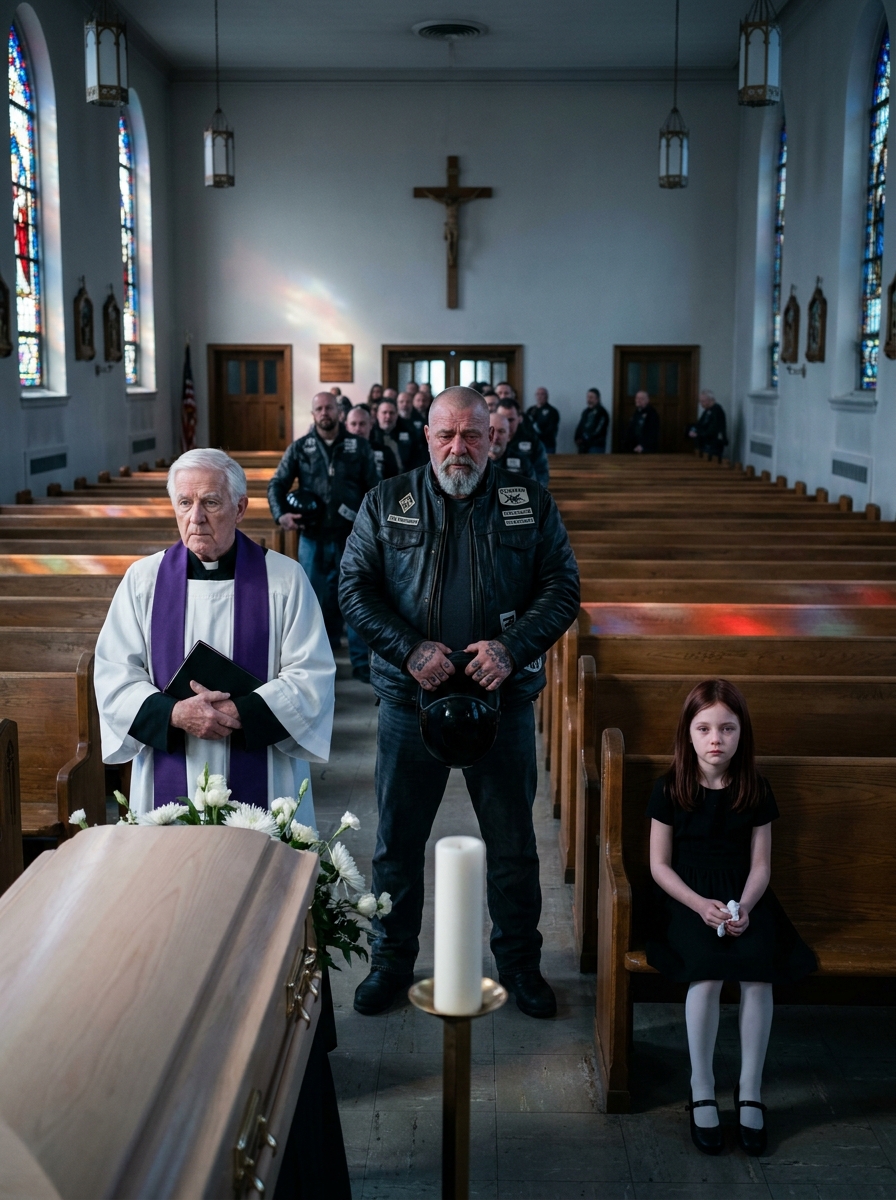
The Pagans Motorcycle Club, eastern Pennsylvania chapter, had been holding their weekly chapter meetings at a small clubhouse about four blocks from Loretta’s since 1989. The chapter, by 2003, had thirty-seven patched members. About thirty of them had attended any given Thursday-night meeting in the early 2000s.
Sometime in late 1997 — I do not have an exact date and the brothers themselves disagree on it — the chapter had begun the tradition of going to Loretta’s for an early dinner together every Thursday evening before their weekly chapter meeting. They would arrive at the diner at about 5:30 p.m. They would push three tables together. They would order. They would eat. They would tip well. They would leave at approximately 6:45 p.m. to ride the four blocks to the clubhouse for their 7:00 p.m. meeting.
They had been doing this every Thursday for the entire six years my mother had been working there.
She had been their primary waitress every single Thursday.
I had not, at the age of nine, known any of this.
I had known that my mother worked at a diner. I had been to the diner, with her, on the back of a small folding chair behind the counter, more times than I could count between the ages of three and nine. I had eaten more grilled cheese sandwiches at Loretta’s counter than at our own apartment kitchen table.
I had never, however, been at Loretta’s on a Thursday night.
My mother had specifically arranged her hours, with Loretta’s full understanding, so that her Thursday-night shift was the one shift each week when I was being cared for by our elderly downstairs neighbor Mrs. Olga Yaworski — a kind Polish-American widow who I had called “Babcia Olga” my entire short life — at our apartment. The reasoning my mother had given me, when I was old enough to ask, had been simple. She had said, “Hannah, sweetheart. Thursday nights at the diner are for grown-ups. The customers are grown-ups. The bar is open. You stay home with Babcia Olga on Thursdays. Wednesdays and Saturdays you can come if you want.”
I had accepted that explanation without question for six years.
I had assumed, in the way a small child assumes, that “the customers are grown-ups” meant something fairly innocuous about adult conversation and adult drinking.
I had not known, in any conscious way, that my mother spent every Thursday evening of my entire conscious life serving food and coffee to thirty patched members of the Pagans Motorcycle Club.
She had not, by her own deliberate choice, ever told me.
She had not, by any of the brothers’ own honest later accounts to me as I grew up, ever asked any of them to keep a secret. She had simply, in the way she had handled most things, decided that her daughter was nine years old and that there was no reason to confuse her about who her mother’s customers were until her daughter was old enough to ask.
She had not lived to see the age at which I would have asked.
She had served them their last meal on Thursday October 9th, 2003 — two days before her death.
She had brought them, at table 7 at the back of the diner, the same orders she had been bringing them for six years. She had remembered, by every brother’s later account, every modification on every order. Extra crispy bacon for one. No onions for another. Egg substitute for a third whose cardiologist had been on him for a year. Decaf coffee after 7:00 p.m. for the older members. Real coffee for the younger members who could still process caffeine after dinner without ruining their sleep.
She had, by every brother’s account, called every man at the table by his first name. Not by his road name. Not by his cut name. By his actual given name. She had been the only person in the entire diner, including Loretta, who had consistently done that.
She had also, by every brother’s account, given several of them extra hash browns at no charge for years, as a small private courtesy that Loretta knew about and tolerated.
She had, in the way she handled small things, treated the thirty patched members of the eastern Pennsylvania Pagans chapter as exactly what they were to her — thirty individual men who tipped well, who never gave her trouble, and who had become, over six years, something close to thirty Thursday-night regulars who she liked.
She had not, by any account, ever flirted with any of them. She had not been romantically involved with any of them. She had not, by any of the brothers’ insistence to me later, ever been the subject of a single inappropriate comment from a single brother in six years. Their chapter VP — Edmund “Cap” Whitlock, the man who would stand up at her funeral — had made it clear from the first Thursday she had served them that their relationship with the diner’s primary waitress was a relationship of professional courtesy and personal warmth, and nothing else.
She had been, to them, simply Maeve.
They had not known, until 11:47 p.m. on the night of Saturday October 11th, 2003, that she had passed away.
They had not known, until the morning of Monday October 13th, 2003, that she had a nine-year-old daughter.
The way they had found out is the part of the story that nobody, including me, knew about until 2014, when I was twenty years old, and the chapter’s then-president — a man named Frank “Big Frank” Demitrius — had told me the whole thing on his back porch in Bethlehem, Pennsylvania.
The way they had found out had been simple.
They had ridden to the diner on Thursday October 9th, 2003. My mother had served them. They had eaten. They had ridden to the clubhouse. They had had their meeting.
They had not seen her again.
They had ridden to the diner the following Thursday — October 16th, 2003 — and they had been told by Loretta, who had been crying behind the counter, that Maeve had passed away the previous Saturday. That her funeral had been three days earlier, on Tuesday October 14th. That she had had a nine-year-old daughter named Hannah who had been placed with Lehigh County Children and Youth Services. That nobody in the diner had known, at the time of the funeral, who to tell. That Loretta had heard about the funeral the next morning, October 15th, from Mrs. Holzapfel, who had called the diner to ask whether Loretta had any forwarding contact information for Maeve’s family.
Loretta had not.
The brothers had, by Big Frank’s later account, sat in the diner at table 7 — three of them, that morning of October 16th, who had ridden together to a Thursday lunch instead of the usual Thursday dinner — and they had listened to Loretta cry.
They had ordered nothing.
They had paid for the coffee they had not ordered with a hundred-dollar bill.
They had ridden back to the clubhouse.
They had called an emergency chapter meeting for that same evening.
By 8:14 p.m. on Thursday October 16th, 2003 — five days after my mother’s death, two days after her funeral, and forty-eight hours after they had found out about it — the thirty patched members of the eastern Pennsylvania chapter of the Pagans Motorcycle Club had voted unanimously on a single motion.
The motion, by the chapter’s official meeting log that I have since been allowed to read, had been:
“That this chapter, having failed by no fault of our own to attend the funeral of a working woman who served us with kindness for six years, will now find her daughter and offer ourselves as godfathers, in whatever form the daughter and her caseworker will permit, for as long as the daughter wants us, with no expectation of return, and no condition attached. Motion made by VP Whitlock. Seconded by President Demitrius. Vote: 30 in favor, 0 opposed, 0 abstentions.”
They had found me at Mrs. Holzapfel’s house in Whitehall the following Saturday morning, October 18th, 2003.
What had happened on Mrs. Holzapfel’s porch that morning — and what their president and VP had said to her — is what the rest of this story is about.
I want to tell you what I remember, as a nine-year-old, of the day they came to Mrs. Holzapfel’s house.
It had been a cold Saturday morning. Late October. The leaves on the maple trees in Mrs. Holzapfel’s front yard had been at their peak red. I had been sitting at the kitchen table eating a bowl of Rice Krispies with a banana sliced on top, in my pajamas, watching cartoons on a small television in the next room.
Mrs. Holzapfel had been at the kitchen sink doing dishes.
We had heard, faintly, the rumble of a large group of motorcycles approaching the house from the south.
Mrs. Holzapfel had, by her later account, recognized the sound and walked to the front window.
She had said, very quietly, “Glen. Get up here.”
Mr. Holzapfel — who had been in the basement working on a small woodworking project — had come up.
They had stood at the front window together.
They had watched.
I had walked to the window with them.
I had seen, parked in front of Mrs. Holzapfel’s small ranch house in Whitehall, thirty Harley-Davidson motorcycles. The riders had been getting off the bikes and walking, slowly, in a loose group of three, up the small concrete walkway to her front door.
The lead rider had been a tall thin man with a short gray beard, glasses, and a worn black leather cut. He had been walking slightly ahead of the other two. He had been carrying nothing in his hands. The other two had been carrying small things — one had been carrying a small wrapped package, and the other had been carrying a small folded piece of paper.
Mrs. Holzapfel had, by her own account in 2014, briefly considered calling the police.
She had decided, before they reached the front door, not to.
She had decided not to because of the way the lead rider had walked. He had been walking, by her own description, “the way a man walks when he has been to a lot of difficult places and he does not want to make this one of them.”
She had opened the door before they had knocked.
The lead rider had stopped about four feet from the doorway.
He had taken his glasses off.
He had said, “Ma’am. My name is Frank Demitrius. I am the chapter president of the eastern Pennsylvania Pagans Motorcycle Club. I am not here to upset you, ma’am. I am not here to ask you for anything. I am here because we found out two days ago that a woman who waited on our table at a diner in Allentown for six years passed away last weekend. We did not know about her funeral. We were not at her funeral. We have been told that her nine-year-old daughter is in your care and that the daughter has no other family. I am here, ma’am, with two of my brothers, to ask you a single question. With your permission. With your full ability to say no. With no further communication from us if you say no.”
Mrs. Holzapfel had said, “Ask the question, Mr. Demitrius.”
He had said, “Ma’am. Would you allow our chapter — thirty men, all patched, all on file with the Pennsylvania State Police, with no objection from any law enforcement agency we have spoken to in the last forty-eight hours about this specific question — to invite Maeve’s daughter to dinner at the diner on Thursday nights, for as long as the daughter wants to come, with you or another guardian present at every dinner if you want to be, with no expectation of any kind, with the only purpose being that we want her mother’s daughter to have a meal with us once a week the way her mother had a shift with us once a week. Ma’am. We want to feed her. We do not want anything else.”
Mrs. Holzapfel had stood at the doorway for a long moment.
Then she had said, “Mr. Demitrius. Come in. All three of you. Mr. Holzapfel and I want to talk to you.”
They had come in.
They had sat at Mrs. Holzapfel’s kitchen table.
Mrs. Holzapfel had made them coffee.
I had sat in the next room watching cartoons, pretending not to listen, listening to every single word.
They had talked for almost two hours.
By the end of those two hours, Mrs. Holzapfel — who had been a professional child welfare social worker for nineteen years, who had handled hundreds of difficult emergency placements, who had a sharper instinct for adults who were lying than almost anyone I have ever met — had been crying.
She had been crying because, by her own later account, the lead rider Frank Demitrius had said to her, at one point in the conversation, the following sentence:
“Mrs. Holzapfel. I want to be honest with you. Our patch is the patch of an organization that has done things, over fifty years, that I will not defend to you. Some brothers in the larger organization have done things that I would not want my own children near. But this is not the larger organization. This is one chapter, in eastern Pennsylvania, with thirty men, all of whom are working men with day jobs and most of whom are fathers themselves, and all thirty of whom voted at our chapter meeting on Thursday night that we owe Maeve’s daughter a Thursday dinner. We are not asking to take her. We are not asking to be her guardians. We are asking to be present. We are asking to be regular. We are asking to feed her. That is all.”
He had paused.
He had said, “Mrs. Holzapfel. Maeve served us coffee for six years. She called us by our names. She gave us extra hash browns at no charge. She made our Thursday nights, every week, slightly better than they would have been. She was a working mother. She is gone. We did not get to thank her. We did not get to be at her service. We did not even know her last name until Saturday. We are not asking you to forgive us for any of that. We are asking you to let us be a small part of her daughter’s growing-up so that the working mother we did not get to honor can be honored, anyway, every Thursday, for as long as her daughter will let us.”
Mrs. Holzapfel had cried.
She had cried at her kitchen table in front of three patched bikers for about ten minutes.
She had then, by her own later account, called Father Anthony Brennan at Saint Anastasia Catholic Church and asked him whether the priest who had buried Maeve Pendergast on Tuesday October 14th, 2003, would be willing to come over to her house in Whitehall, on a Saturday morning, to advise on a complicated child-welfare question.
Father Brennan had come over.
He had arrived at 11:42 a.m.
He had sat at Mrs. Holzapfel’s kitchen table with the three bikers.
He had, by his own later account in 2014, been more directly impressed by Frank Demitrius’s manner than he had expected.
He had, after about an hour of conversation, asked to be taken to the chapter clubhouse to meet the other twenty-seven brothers.
He had been taken there that afternoon.
He had spent four hours at the clubhouse.
He had returned to Mrs. Holzapfel’s house at 5:14 p.m.
He had said, “Bernadette. Mr. Holzapfel. With my full pastoral endorsement and on my own recommendation as a man who has spent forty-seven years observing human beings, I think this should happen. I think Hannah should go to dinner at the diner on Thursdays. I think we should set up the framework carefully. I think Mrs. Holzapfel should attend the first six dinners with her. I think after that, we should let Hannah herself decide. But I think this should happen.”
Mrs. Holzapfel had agreed.
Mr. Holzapfel had agreed.
Frank Demitrius and the other two brothers — Cap Whitlock and a man I would come to know as “Pretzel” Stevenson — had stood up at the kitchen table.
Frank had, in front of everyone, gone into the next room to ask me himself.
He had knelt down in front of the small armchair where I had been pretending to watch cartoons.
He had said, “Hannah. My name is Frank. Your mama poured us coffee for six years, sweetheart. We are very, very sorry about your mama. We did not know her like you knew her, and we never will. But we knew her every Thursday. Every Thursday for six years she made our dinner just a little bit better than it would have been. She was the best person any of us got to see in any given week.”
He had paused.
He had said, “Hannah. We were not at her funeral, sweetheart. We did not know. If we had known, all thirty of us would have been there. I will never forgive myself for that. None of us will.”
He had paused again.
He had said, “Hannah. We are asking your permission for one thing. Not your guardianship. Not your money. Not your time on any other day. We are asking, sweetheart, if every Thursday, starting next week, you would let us pick you up and take you to the diner where your mama worked, and let thirty of your mama’s regulars buy you dinner and sit with you and remember her with you. With Mrs. Holzapfel right there at the table. For as long as you want. Until you tell us to stop. Sweetheart. Will you let us do that?”
I had been nine years old.
I had thought about it for about ten seconds.
I had said, “Mister. Are you guys going to be sad too?”
He had said, “Yes, sweetheart. We are going to be sad too. For a long time.”
I had said, “Okay. We can be sad together.”
He had said, “Yes, Hannah. We can be sad together.”
He had stood up.
He had walked to the door.
The three of them had ridden away.
The first Thursday dinner had been five days later, on Thursday October 23rd, 2003, at 5:30 p.m., at Loretta’s Family Diner.
I had been picked up by Frank Demitrius and Cap Whitlock and a third brother named Donny “Tank” Petrosky in Tank’s pickup truck. Mrs. Holzapfel had ridden in the front passenger seat with them. I had sat in the back seat between Frank and Cap.
When we had arrived at the diner, the other twenty-seven brothers had been waiting at three pushed-together tables.
Loretta had been crying behind the counter.
The brothers had stood up when I walked in.
All thirty of them.
They had stood there in their cuts.
They had not said anything.
I had, at age nine, walked to the table.
I had sat down at the head of the three pushed-together tables — at the seat my mother had always been told, by every single one of them every single Thursday for six years, was Maeve’s seat, even though she had been the waitress and never the diner.
I had sat in my mother’s seat.
The thirty bikers had sat down around me.
Mrs. Holzapfel had sat at my immediate right.
Frank had sat at my immediate left.
He had said, “Hannah. What do you want for dinner, sweetheart?”
I had said, “Grilled cheese.”
He had said, “Grilled cheese coming right up.”
He had ordered me a grilled cheese, fries, and a small glass of milk.
He had ordered the same coffee my mother had served him every Thursday for six years.
We had eaten dinner.
The brothers had taken turns telling me small stories about my mother — small, careful, age-appropriate stories about things she had said or done over six years that had made their Thursday nights slightly better. The story about the time she had called Pretzel by his real first name — Stanley — in front of his old high school principal who had walked into the diner on a random Thursday night for the first time in twenty years. The story about the time she had brought a small homemade Saint Patrick’s Day card for the chapter on March 17th, 2001, that had three hand-drawn shamrocks on it, that Frank had carried in his wallet for the rest of his life and that I have today, framed, on the wall of my apartment. The story about the time she had memorized a brand-new brother’s order on his very first Thursday, in 2002, before he had said it twice, because she had heard him order it once at a different table earlier in his shift.
I had eaten my grilled cheese.
I had drunk my milk.
I had laughed at some of the stories.
I had cried at others.
The brothers had cried with me.
I had been at the head of the table for two hours.
When dinner had been over, Frank had paid the entire check — all thirty-one of us — in cash.
He had also, by Loretta’s quiet account to me years later, paid an additional one hundred and fifty dollars for a small private commitment that the table at the back of the diner would be held for “Hannah’s table, Thursdays at 5:30 p.m.,” indefinitely, with Loretta agreeing to never seat anyone else at it on a Thursday night.
The table had remained Hannah’s table for the next fifteen years, until Loretta retired and the diner closed in 2018.
I had eaten dinner at that table — with thirty bikers, decreasing slightly in number over the years as men retired and rode less and one or two passed away, but always with at least eighteen at any given Thursday — every Thursday from October 23rd, 2003, until June 14th, 2018.
Seven hundred and sixty-four Thursdays.
I had, by my own count, missed exactly nine of them in fifteen years. Seven for illness. Two for an out-of-state college visit when I was seventeen.
The brothers had not, in fifteen years, missed a single Thursday.
Even the Thursdays when I had been sick, they had still gone to the diner. They had still sat at our table. They had still ordered. They had still eaten. They had still left a chair for me, with a small folded napkin on the seat where I would have sat.
That had been the deal.
That had been the deal for fifteen years.
I want to tell you about Mrs. Holzapfel.
She had attended the first eighteen Thursday dinners with me, between October of 2003 and February of 2004. She had then, with my full agreement and the full agreement of the brothers and Father Brennan, allowed me to begin attending without her — picked up by two brothers in a pickup truck at the front door of her house, dropped off at the front door of her house at 7:30 p.m., with both brothers walking me to the door each time.
She had — and this is the part of the story that I had not understood until 2014, when I was twenty — done one careful thing in the first three months of the dinners that none of the brothers had known about.
She had hired, with her own personal money, a small private investigator she had used in her professional capacity at Lehigh County Children and Youth Services for fourteen years — a retired Allentown Police detective named Mr. Vincent Fiorello — to quietly verify, individually, every single one of the thirty patched members of the eastern Pennsylvania Pagans chapter.
She had wanted to know, before she let a nine-year-old child be alone with thirty men, that none of them had any history of any offense involving children.
Mr. Fiorello had taken three weeks.
He had checked every brother’s full criminal record. He had checked every brother’s federal record. He had checked the Pennsylvania state sex offender registry. He had checked the National Sex Offender Registry. He had cross-referenced employment records, marriage records, divorce records, child custody records.
He had given Mrs. Holzapfel a 47-page typed report on November 14th, 2003 — three weeks after the first dinner.
Mrs. Holzapfel had read the report.
She had then, by her own later account in 2014, made one decision that had shaped the next fifteen years of my life.
She had decided to allow the dinners to continue.
She had decided this because Mr. Fiorello’s report — which I have since been allowed to read — had documented exactly what Frank Demitrius had told her at the kitchen table on October 18th, 2003. Of the thirty patched members of the eastern Pennsylvania Pagans chapter at that time, twenty-six had no criminal record beyond minor traffic violations. Three had old minor non-violent records from their late teens or early twenties — a DUI, a small theft conviction, a possession charge — all from the 1970s, all served, all cleared. One — and this is the part that was the most important, by Mrs. Holzapfel’s own later account — had a single significant felony from 1989 for assault, served, paroled, no further offenses in the fourteen years since.
None of them had any record involving any child or any minor.
None of them had any record involving any sexual offense of any kind.
None of them, by Mr. Fiorello’s careful cross-reference, had any pattern of behavior that suggested they were the kind of men who would harm a nine-year-old in their care.
They had been, on paper, what they had said they were.
Mrs. Holzapfel had locked the report in a small fireproof box at her house.
She had not told me about it for eleven years.
She had told me, on a Saturday afternoon in March of 2014 when I was twenty years old, on her back porch in Whitehall.
She had said, “Hannah, sweetheart. I want you to know that I did not let those men take you to dinner without checking. I checked every single one of them. I checked them in the way I had checked hundreds of men in my career. They had told me the truth. I am telling you this now because you are an adult and because someday you are going to have your own child and you are going to need to know how to think about the men in your life. The way you think about it is: you check. And then if the check comes back clean and the men are who they said they were, you trust them. And if you trust them, you let them love your child. That is what I did for you. That is what I did with all of them.”
I had cried for about an hour on her back porch.
She had held my hand the entire time.
She had passed away in 2019, three years after she had retired from Lehigh County Children and Youth Services, of complications of pancreatic cancer.
I had given her eulogy.
Twenty-three of the thirty bikers had attended her funeral. The other seven had been physically unable to travel.
Frank Demitrius — who had stepped down as chapter president in 2013 and had been an emeritus member ever since — had been the first man to walk up to Mrs. Holzapfel’s casket after the family viewing.
He had placed, on the closed casket, a single small folded napkin from Loretta’s Family Diner — the same kind of folded napkin that had been left on Hannah’s table on the nine Thursdays I had missed in fifteen years.
He had said, very quietly, “Bernadette. Thank you. From all of us.”
He had walked back to his pew.
He had cried for the rest of the service.
I want to tell you what I have today.
I have a small two-bedroom apartment in Allentown. I have a teaching job I love at a public elementary school where the principal — a kind woman named Mrs. Constance Ahrens — knows the entire story of my childhood and has been one of my biggest professional advocates for six years.
I have a fiancé named Jake Wernicke who I am going to marry on the second Saturday of May 2026.
I have, by every measure that matters to me, the best support system any person could ask for.
I have twenty-six godfathers in their cuts who are going to walk into the small ceremony venue together. I have two more who will be on a video screen. I have two empty chairs in the front row for Cap Whitlock and Tank Petrosky, who passed away in 2017 and 2021 respectively.
I have a small framed shamrock card on the wall of my apartment, in my mother’s handwriting, dated March 17th, 2001, that Frank Demitrius carried in his wallet for the next fifteen years before he gave it to me on my eighteenth birthday.
I have, by my own savings — accumulated through small monthly birthday gifts that thirty bikers have been depositing into a small custodial account in my name since I was ten years old — enough money to pay for the entire wedding without asking my fiancé’s family to contribute a single dollar.
The brothers have, between 2004 and 2025, deposited just over $94,000 into that account. None of them, ever, has asked me how I planned to spend it. None of them has expected anything specific. They have simply, by Frank Demitrius’s quiet leadership in 2003, made a chapter-level decision that the daughter of the woman who poured them coffee for six years would not, if any one of them could prevent it, ever want for anything that money could solve.
I have not, in twenty-two years, ever wanted for anything that money could solve.
I have also, in twenty-two years, had thirty men teach me how to fix a flat tire, how to balance a checkbook, how to file my own taxes, how to negotiate a starting salary, how to choose a reliable used car, how to give a tough but fair employee review, how to host a Thanksgiving dinner for thirty people, how to write a college admissions essay, how to grieve, how to forgive, how to ask for help, and how to recognize a kind man from across a crowded room.
I learned the last one when I met Jake.
I knew, by the time we had been on our third date, that he was a kind man.
I knew because I had been raised, since the age of nine, by thirty other kind men.
The pattern was familiar.
I had recognized it.
That is the entire story.
Loretta’s Family Diner closed in 2018.
The thirty bikers and I — by then twenty-eight of us, after Cap had passed in 2017 — moved our Thursday dinners to a small Italian restaurant called Sal’s on Hamilton Boulevard. We have been at Sal’s every Thursday since.
The owner, Mr. Salvatore Caruso, knows the whole story.
He keeps a table for us at the back.
He calls it Hannah’s table.
He has been calling it that since 2018.
When I am married next May, I am going to bring my husband to a Thursday dinner at Sal’s on the Thursday before our wedding. The brothers have already arranged it. They have already told Mr. Caruso. There will be twenty-eight men at the table. Two empty chairs for Cap and Tank. One chair for me.
One chair, for the first time in twenty-three years, for the man my chapter brothers have agreed to formally welcome to Hannah’s table.
His name is Jake.
He has met all twenty-eight of them, individually, over the last four years.
He has, by Frank Demitrius’s careful private endorsement at our small engagement party in March of 2025, been formally vouched for by every single one of them.
He is, by my own quiet count, the only man any of the thirty bikers in my life have ever vouched for as a husband for me.
I am going to marry him.
I am going to bring him to Hannah’s table on the Thursday before the wedding.
The brothers are going to feed him.
The deal continues.
I will tell you the smallest version of this story, in case you skipped to the end.
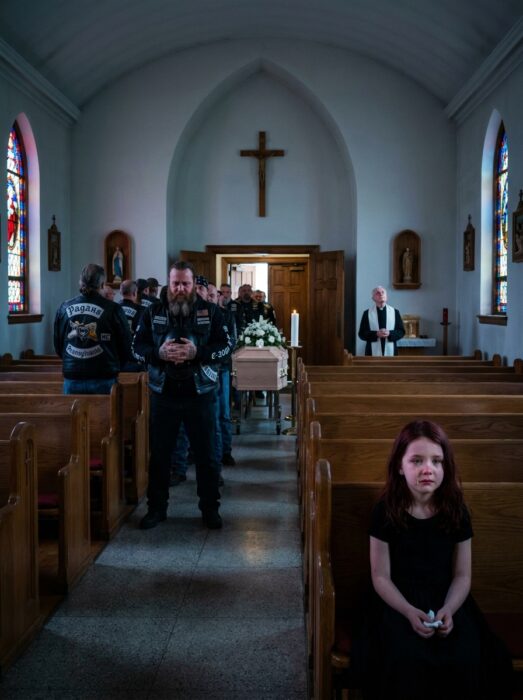
A nine-year-old girl sat alone in the front pew at her mother’s funeral on Tuesday October 14th, 2003, in a small Catholic church in Allentown, Pennsylvania.
The doors opened.
Thirty patched members of the eastern Pennsylvania chapter of the Pagans Motorcycle Club walked in.
They had not known about the funeral until the morning of the funeral.
They had ridden as soon as they had heard.
Their vice president stood up at the appropriate moment in the service and told the church that the woman in the casket had served them coffee for six years and that she had called every man in the chapter by his real first name.
After the service, their president knelt down in front of the nine-year-old girl in the front pew and asked her one question.
The question was whether she would allow thirty bikers to take her to dinner at her mother’s diner every Thursday, for as long as she wanted.
She had said yes.
Seven hundred and sixty-four Thursdays later, at the age of twenty-four, she met a kind man named Jake.
She is going to marry him in May of 2026.
She is going to bring him to Hannah’s table on the Thursday before the wedding.
The deal — the deal her thirty godfathers made with a nine-year-old girl on Saturday October 18th, 2003, on a porch in Whitehall, Pennsylvania — has been honored every Thursday for twenty-two years.
It is going to be honored, by my own count, for the rest of my life.
That is the entire story.
If this story moved you — follow the page. There are more men out there who waited a week to find out the woman who poured them coffee had a nine-year-old daughter. More social workers who hired private investigators on their own dime to verify thirty bikers in 2003. More tables held at small diners for fifteen years for one regular who was nine years old when she started showing up. There are more stories the world doesn’t see — and I will keep telling them as long as someone keeps reading.