I knew Sophie because I drove past Cedar Hollow Road every morning on my way to work.
I knew Erin because everyone knew Erin.
Not in the gossip way.
In the tired admiration way.
She was the woman carrying two grocery bags and a backpack at 10:30 at night. The woman scraping ice off her windshield in a diner uniform before sunrise. The woman sitting in her car for three minutes before going inside because sometimes those three minutes were the only quiet she got all day.
She did not ask for help easily.
Pride, maybe.
Or fear.
People like Erin learn early that help often comes with a bill hidden inside it. Advice. Judgment. Pity. A story repeated at church. A favor remembered too long.
So she kept moving.
Morning shift.
School drop-off.
Laundry.
Second shift.
Homework at the kitchen table.
Microwave dinners.
Goodnight kisses.
Then again.
Sophie knew her mother was tired.
That was part of the problem.
She stopped telling Erin everything because she could see what each new pain did to her mother’s face.
Children protect parents more than parents know.
At school, the bullying started small.
A whisper about her shoes.
A laugh about her backpack.
A girl named Madison pinching the sleeve of Sophie’s sweater and saying, “My grandma has a couch like this.”
The others laughed.
Sophie tried to laugh too.
That is what kids do when they are deciding whether humiliation hurts less if they pretend it was a joke.
It got worse.
Someone put a sticky note on Sophie’s back that said FREE CLOTHES NEEDED.
Someone dumped pencil shavings into her lunchbox.
Someone asked if her mother shopped from trash cans.
Sophie did not fight.
She got quiet.
Then quieter.
By October, she cried every morning.
That was when Brick started listening without meaning to.
Brick had lived on Cedar Hollow Road for eleven months. He rented the last house after his divorce became final and his adult son stopped answering calls. Before that, he had spent twenty years in the Marine Corps and another ten years trying to figure out who he was when nobody gave him orders.
He was not friendly.
Not unfriendly either.
Just contained.
The kind of man who had learned to keep himself behind locked doors.
People noticed his vest before anything else.
Iron Order.
Some thought it meant outlaw.
Some thought it meant danger.
Some just saw a biker and stopped thinking.
Brick never corrected them.
He had no patience for defending the surface of himself to strangers who already enjoyed being wrong.
But he noticed things.
Marines do.
Bikers do too.
A strange car parked too long.
A child walking slower each week.
A mother’s shoulders getting heavier.
A lunchbox held close like armor.
The first seed was the orange cat.
Every evening, that half-starved stray sat on Brick’s porch rail. Brick pretended to hate it.
“Damn freeloader,” he muttered.
Then he put down a bowl of food.
Sophie saw that once.
She had been walking home with Erin. The cat rubbed against Brick’s boot, and Brick looked down like he had been insulted.
Sophie smiled.
Just a little.
Brick saw it.
He said, “Don’t tell nobody.”
Sophie whispered, “Okay.”
The second seed was Brick’s old Marine pin.
Not on the outside of his vest.
Inside.
Pinned near the lining where most people would never see it. A small eagle, globe, and anchor, dulled from years of wear. He touched it sometimes before starting his Harley.
The third seed was a photograph taped to the inside of his garage cabinet.
A boy around ten years old, grinning on a bicycle beside a younger Brick in desert camo. Brick’s son, Daniel. People did not know about him because Brick never mentioned him.
Sophie noticed the photo later.
But not yet.
First, she noticed that Brick listened like the road listened.
Quiet.
Wide.
No rushing.
When he sat beside her on the curb that first morning, she expected advice.
Adults always had advice.
Ignore them.
Be kind.
Tell a teacher.
Stand up for yourself.
They mean it well, but advice can feel like another assignment when you are eight and already exhausted.
Brick did not give advice.
He asked three questions.
“What are their names?”
“Where do they wait?”
“Does the teacher know?”
Sophie answered the first two.
For the third, she looked down.
Brick understood.
Not fully.
Enough.
He stood up, joints stiff, leather creaking.
Erin came down the porch steps fast, worried now.
“Is everything okay?”
Brick looked at her.
The man was frightening up close. Huge. Tattooed. Gray beard. Voice like gravel dragged under a truck.
“No, ma’am,” he said. “But it will be.”
Erin did not know what that meant.
The next morning, she found out.
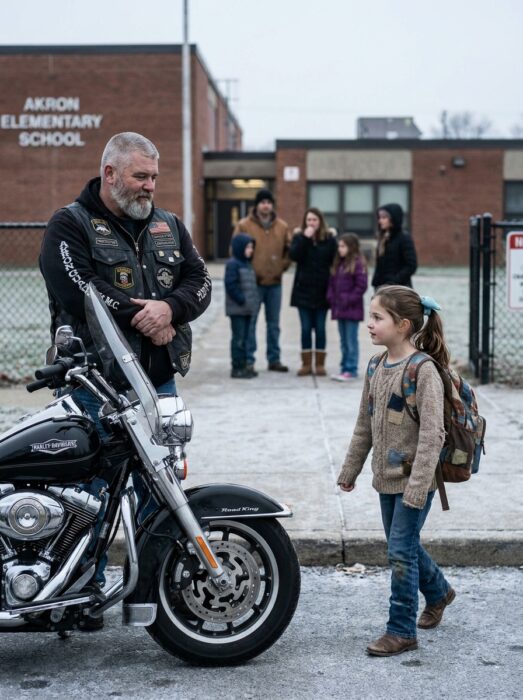
Brick arrived at Ridgeview Elementary at 7:38.
School started at 7:55.
He was early on purpose.
The black Harley rolled into the visitor parking area with a low thunder that cut through the morning chaos of minivans, buses, slamming doors, and parents shouting reminders about lunches and jackets.
He did not rev the engine.
That mattered.
Men showing off rev.
Men making a point do not have to.
Brick parked across the street from the front gate, backed the Harley into a space, killed the engine, removed his gloves, and leaned against the seat.
Arms folded.
Boots planted.
Leather vest visible.
Face unreadable.
The crossing guard stared.
Parents stared.
Children stared hardest.
Sophie arrived six minutes later in Erin’s old silver Honda.
Erin saw Brick first.
Her face changed from confusion to concern to something close to understanding.
Sophie sat frozen in the passenger seat.
“You don’t have to,” Erin said softly.
Sophie looked toward the gate.
Madison and two other girls were already there.
Clean coats.
Matching backpacks.
Bright hair bows.
The kind of confidence children wear when they know the world has never made them explain why their shoes are old.
Then Sophie looked at Brick.
He did not wave.
Did not smile big.
Did not perform kindness.
He just gave one small nod.
Like a soldier at a gate.
Like a man saying, Move forward. I have this side.
Sophie got out.
Her backpack looked too heavy.
Her hair ribbon had come loose.
She walked toward the school.
The three girls spotted her.
Madison opened her mouth.
Then saw Brick.
Her mouth closed.
Children understand power faster than adults do.
One of the girls leaned toward Sophie and whispered, “Who is that?”
Sophie stopped.
For one second, she looked like the lie would choke her.
Then she said, “My dad.”
Brick heard her.
I know because his jaw moved once.
But he did not correct her.
Not there.
Not in front of them.
Sophie walked through the gate without anyone laughing.
That day, she ate lunch without pencil shavings in her food.
Nobody touched her backpack.
Nobody called her trash bag.
The next morning, Brick came again.
Same time.
Same place.
Harley parked.
Boots planted.
Arms folded.
A nod when Sophie arrived.
Then again on Wednesday.
Thursday.
Friday.
By the second week, the school had noticed.
The principal, Mrs. Harlan, came outside.
She was a Black American woman in her late forties with sharp glasses, a careful voice, and no patience for nonsense.
“Sir,” she said, “can I help you?”
Brick stood straight.
“No, ma’am.”
“Are you waiting for a student?”
“Yes, ma’am.”
“Which student?”
Brick paused.
“Sophie Miller.”
Mrs. Harlan looked toward the building.
“And your relation?”
Brick looked at the gate.
That was where the false climax almost happened.
He could have lied.
He could have said uncle.
Family friend.
Guardian.
He didn’t.
“Neighbor,” he said.
Mrs. Harlan studied him.
“Does her mother know you’re here?”
“Yes, ma’am.”
That was true by then.
Erin knew.
She had tried to thank him on day three.
Brick cut her off.
“Kid’s gotta get through a door. I can stand outside one.”
Mrs. Harlan looked at the Harley.
Then at the children entering safely.
Then back at Brick.
“You cannot intimidate students.”
Brick’s face did not change.
“Not my intention.”
“What is your intention?”
He looked at Sophie, who had just stepped inside the building with her head a little higher than before.
“To be visible.”
Mrs. Harlan was quiet for a long moment.
Then she said, “Stay across the street.”
“Yes, ma’am.”
“And no interacting with children who are not Sophie.”
“Yes, ma’am.”
“And if this becomes a problem—”
“I’ll leave.”
Mrs. Harlan nodded.
But she did not ask him to leave that day.
For three months, Brick stood outside Ridgeview Elementary every morning.
Rain.
Cold.
Wind.
Once, light snow.
He never entered.
Never spoke to Madison or the other girls.
Never threatened anyone.
He simply stood there.
And Sophie stopped crying.
That should have been the whole story.
A rough biker scaring bullies away.
But that was not the real point.
The real point came on parent night.
Parent night happened in January.
Ridgeview Elementary called it a “Family Partnership Evening,” which sounded warmer than “Come Sit in Tiny Chairs Under Fluorescent Lights While Teachers Explain Your Child’s Progress.”
Erin almost did not go.
She had worked a double the day before and a breakfast shift that morning. Her uniform still smelled faintly of coffee and fryer oil. She had circles under her eyes. Her car needed gas. Her feet hurt.
But Sophie begged.
Not loudly.
Just stood by the door in her blue sweater and said, “Please come.”
So Erin went.
And she invited Brick.
That was the part nobody expected.
She knocked on his door at 5:10, still in her diner shoes.
Brick opened it wearing a black T-shirt, jeans, and reading glasses low on his nose. That startled her more than the vest ever had.
“I need to ask something,” Erin said.
Brick removed the glasses.
“What?”
“Sophie wants you there tonight.”
He frowned.
“At school?”
“Parent night.”
“I ain’t her parent.”
“I know.”
He looked down the road.
“She knows?”
Erin smiled sadly.
“She knows what you are.”
“What’s that?”
Erin’s voice softened.
“Someone who showed up.”
Brick looked uncomfortable.
Men like him can handle insults better than gratitude.
He almost said no.
Then Sophie stepped from behind her mother’s car, holding a folder of schoolwork.
“Please,” she said.
Brick looked at that folder.
Then at the little girl who no longer cried every morning but still checked the school gate before walking in.
He nodded once.
“Give me ten.”
He came out wearing the leather vest.
Not for show.
For armor.
The school cafeteria was packed when they arrived. Parents sat at long tables. Kids showed off drawings taped to walls. Teachers moved around with clipboards. The air smelled like floor wax, pizza, and paper.
Brick walked in behind Erin and Sophie.
The room noticed.
Of course it did.
A huge white American biker in an Iron Order vest, tattooed arms, gray beard, heavy boots, moving through a cafeteria full of PTA parents and children with juice boxes.
Conversations thinned.
Sophie reached for his hand.
That surprised him.
He looked down.
Her fingers were small around his scarred knuckles.
Brick let her hold on.
At Sophie’s classroom table, Mrs. Patel, her teacher, smiled warmly.
“I’m glad you all could come.”
Erin sat.
Sophie sat between her and Brick.
Brick lowered himself into a tiny plastic chair that looked one bad decision away from becoming a lawsuit.
Sophie giggled.
He leaned down and muttered, “If I die in this chair, tell the cat he was adopted.”
She laughed.
A real laugh.
Then Mrs. Patel looked at her notes and said, “Sophie has made remarkable progress socially this quarter. She seems much more confident. She mentioned her father has been helping her feel safe at drop-off.”
The table went silent.
Erin’s face flushed.
She opened her mouth.
Brick put one hand gently on the table.
Not stopping her.
Just asking for a second.
Mrs. Patel looked confused.
Sophie gripped Brick’s hand tighter.
Brick stood.
The little chair squeaked in relief.
Several parents turned.
Madison’s mother was at the next table.
So were two other parents whose daughters had once waited by the gate.
Brick cleared his throat.
“I’m not Sophie’s father,” he said.
The cafeteria quieted in sections.
Like a sound system being turned down.
Brick kept his eyes forward.
“I’m her neighbor.”
Erin looked at him, worried.
Sophie did not let go of his hand.
Brick continued.
“I stood outside that gate because this child was scared to walk into school.”
No one moved.
“I served twenty years in the Marines. I guarded roads in countries most of you only see on maps. I stood posts for people who didn’t know my name and never would.”
His voice stayed low.
No drama.
No performance.
“I can stand across the street for a little girl on my block.”
That was the twist.
Brick had not been pretending to be her father.
He had not been trying to replace anyone.
He had simply treated the school gate like a post.
And Sophie like someone worth protecting.
He looked toward the parents.
“No child should wake up crying because they’re poor. No child should be afraid of a hallway because her clothes came from a thrift store. And no mother working two shifts should have to feel like she failed because other people’s kids learned cruelty faster than kindness.”
Madison’s mother looked down.
Mrs. Patel had tears in her eyes.
Mrs. Harlan, the principal, stood near the cafeteria doors with her arms folded.
Brick nodded toward her.
“I didn’t come inside because that wasn’t my place. But I could stand outside. So I did.”
For one second, nobody clapped.
The silence was too full.
Then an older father at the back stood and began applauding.
One clap.
Then another.
Then the room followed.
Not wild.
Not movie-perfect.
But steady.
A room full of adults realizing a man they had judged by leather and tattoos had done what many of them should have done sooner.
Sophie looked up at Brick.
Her face had changed.
Not because the room clapped for him.
Because he had told the truth and stayed.
She lifted her hand.
Still holding his.
And waved at everyone.
For the first time anyone could remember, Sophie Miller smiled at school.
After parent night, the story spread.
That is what stories do in towns.
Some people made Brick bigger than he was.
Hero.
Guardian angel.
Marine biker saves bullied girl.
Brick hated all of that.
When a local reporter called the body shop, he hung up before the man finished saying “human interest.”
When someone at the diner tried to buy his breakfast, he left money under the plate.
When Erin thanked him again, he said, “Don’t make it weird.”
But things did change.
Mrs. Harlan began a school-wide anti-bullying program, though she did not call it that at first. She called it “Belonging Week,” because schools love gentle names for hard problems.
Mrs. Patel moved Sophie’s seat.
Not to hide her.
To place her with kinder children.
Madison and the other girls were made to apologize, but the better change happened when their parents had to sit with Mrs. Harlan and hear exactly what had been said.
Poverty is one of those things adults pretend children invent on their own.
They don’t.
Children repeat what the world teaches them is shameful.
That was hard for some parents to hear.
Good.
Sophie began walking into school without looking at the ground.
She still wore old clothes.
That did not magically change.
But a few things appeared.
A new backpack, left anonymously at Erin’s door.
A winter coat, “extra from my niece,” though the tags were still on.
A pair of sneakers in Sophie’s size, delivered by Mrs. Patel with a story nobody believed but everyone accepted.
Erin cried over those sneakers in the laundry room because she did not want Sophie to see.
Brick saw more than people thought.
He did not like charity that made a person feel smaller.
So he handled things differently.
One Saturday, he knocked on Erin’s door holding a cardboard box.
“Garage sale leftovers,” he said.
Erin looked inside.
Children’s books.
Art supplies.
A warm hoodie.
A lunchbox.
All new.
She looked at him.
“Brick.”
He lifted one hand.
“Leftovers.”
“From what garage sale?”
He pointed vaguely down the road.
“The garage kind.”
She almost laughed.
Sophie came to the door.
“Is that for me?”
Brick shrugged.
“If it fits.”
She pulled out a sketchbook.
Her eyes widened.
Brick nodded toward it.
“Figured you need somewhere to put all that thinking.”
That was the first revelation.
Brick remembered everything.
He remembered Sophie liked drawing because she once sketched the orange cat on a napkin while waiting for Erin to find her keys.
He remembered her favorite color was blue because of the ribbon.
He remembered she hated pink because Madison wore pink every day.
So nothing in the box was pink.
The second revelation came when Sophie saw the photo inside Brick’s garage.
It happened in February.
Erin’s Honda would not start, and Brick came over to jump it. Sophie followed him back to his garage because she wanted to see the orange cat, who had officially moved from freeloader to “security.”
The garage smelled like oil, leather, metal, and cat food.
Tools hung in straight lines.
The Harley sat near the door.
On the inside of a cabinet was a photo.
A young boy on a bicycle beside a younger Brick in desert camo.
Sophie pointed.
“Who’s that?”
Brick looked at the photo.
For a moment, his face shut down.
“My son.”
“What’s his name?”
“Daniel.”
“Where is he?”
Brick wiped his hands on a rag.
“Arizona.”
“Does he visit?”
“No.”
Sophie understood the shape of that no.
Children do.
“Why?”
Brick looked at the Harley.
“I was gone too much when he was little. Then I came back and didn’t know how to be here right.”
Sophie looked at the photo again.
“Does he know you stand at school?”
Brick snorted softly.
“No.”
“You should tell him.”
“Maybe.”
That was the second seed returning.
Brick was not standing outside the school only because Sophie needed a protector.
He was standing there because once, long ago, he had failed to be present for a child who needed him.
Not because he did not love Daniel.
Because he thought providing and protecting were the same as being known.
The Marines taught him how to stand post.
Fatherhood had asked for something harder.
After Sophie left, Brick sat in the garage for a long time.
Then he took out his phone and typed a message to a number he had not used in six months.
Saw a kid at school smile today. Made me think of you at eight. Hope you’re good.
He almost deleted it.
Then sent it.
Three hours later, Daniel replied.
That’s random. I’m okay.
Brick stared at the screen like it had started breathing.
Then he typed:
I wasn’t always good at showing up. I’m sorry.
No reply came that night.
But the message stayed blue.
Not blocked.
For Brick, that was enough to sleep on.
Spring came slowly to Akron.
Snow melted into gray slush.
The school fence stopped looking so sharp.
Kids shed heavy coats and remembered how to run.
Brick still stood outside the gate.
Not every day anymore.
Sophie did not need every day.
That mattered.
Protection that never lets a child walk alone can become another cage.
So Brick changed the ritual.
Mondays and Fridays, he parked the Harley across the street.
Other days, he rode past slowly on his way to work, just enough for Sophie to hear the engine and know the road had a witness.
She no longer told people he was her dad.
She told them the truth.
“That’s Brick. He’s my neighbor.”
Some kids asked if he was scary.
Sophie said, “Only if you’re mean.”
That answer satisfied everyone.
The orange cat got a name.
Sergeant Waffles.
Brick claimed he hated it.
He bought a collar anyway.
Erin’s life did not become easy.
She still worked too much.
Still worried about rent.
Still stretched groceries.
But she was not alone in the same way.
Mrs. Harlan helped connect her with a school assistance program.
Mrs. Patel sent home extra reading books.
A neighbor fixed the Honda’s heater.
Brick changed the brake pads and refused payment.
Erin left a pie on his porch.
He returned the empty plate with a note:
Too much cinnamon. Acceptable.
She laughed for the first time in weeks.
In April, Brick’s son Daniel came to visit.
No motorcycle.
No dramatic reunion.
Just a pickup truck with Arizona plates pulling into Brick’s driveway while Sophie was drawing Sergeant Waffles with a crown.
Daniel was thirty-two now. White American man. Taller than Brick expected. Same jaw. Same guarded eyes. No tattoos. Wedding ring. A daughter of his own, four years old, asleep in a car seat.
Brick stood on the porch like he was facing inspection.
Daniel got out.
For a moment, neither man moved.
Then Daniel said, “So you’re a crossing guard now?”
Brick’s mouth twitched.
“Private security.”
Daniel nodded.
“I heard.”
“From who?”
“Mom still talks to Mrs. Porter. Mrs. Porter talks to everyone.”
Brick looked embarrassed.
Daniel looked toward the school road.
“You really stood out there every morning?”
“Kid was scared.”
Daniel nodded again.
“I was too.”
Brick looked at him then.
The sentence landed hard.
Daniel did not say more.
He did not have to.
Brick stepped down from the porch.
“I know.”
Daniel’s face changed.
Not forgiveness.
Not yet.
But a door opening.
Brick cleared his throat.
“You want coffee?”
Daniel looked at the house.
“Yeah.”
Brick turned, then stopped.
“My coffee’s bad.”
Daniel smiled a little.
“I remember.”
That became another beginning.
Small.
Awkward.
Real.
The last day of school arrived bright and warm.
Sophie wore the blue hoodie Brick had “found” in the garage sale box. Her hair ribbon matched. Her sneakers were clean but scuffed from actual running now.
Erin drove her to Ridgeview Elementary, but this time Sophie did not grip the door handle.
She was excited.
At the gate, Brick stood beside his Harley.
Not because Sophie was afraid.
Because she had asked him to come.
Beside him stood Daniel and Daniel’s little daughter, who was feeding Sergeant Waffles a piece of toast she had smuggled from breakfast.
Mrs. Harlan stood near the entrance.
Mrs. Patel waved from the sidewalk.
Even some parents waved at Brick now.
He hated that.
Secretly, he did not hate all of it.
Sophie got out of the car and ran to him.
Not hiding.
Not shrinking.
She held up a folded piece of paper.
“I made you something.”
Brick took it carefully.
It was a drawing.
A school gate.
A little girl.
A giant biker.
A Harley.
And above them, in crooked second-grade letters:
NO KID SHOULD WALK SCARED.
Brick stared at it too long.
Sophie tilted her head.
“You like it?”
He cleared his throat.
“Yeah.”
“You’re crying?”
“No.”
“Your eyes are wet.”
“Pollen.”
“There’s no flowers.”
“Ohio got sneaky pollen.”
She smiled.
Then she took his big tattooed hand in her small one and waved at the school.
Not because she needed them to see he was there.
Because she wanted them to.
The bell rang.
Children poured inside.
Sophie let go.
She walked through the gate with her head high, blue ribbon moving in the morning light.
Brick stayed until she disappeared inside.
Then he folded the drawing once and tucked it inside his leather vest, right beside the old Marine pin.
His Harley started with a low, steady rumble.
Daniel stood beside him holding his own daughter’s hand.
For a second, Brick looked at the school gate.
Then at his son.
Then down the road.
No orders.
No war.
No post.
Just a child walking unafraid.
And a man finally learning how to stay.
Follow the page for more stories about the people you almost judged before you knew who they were standing guard for.