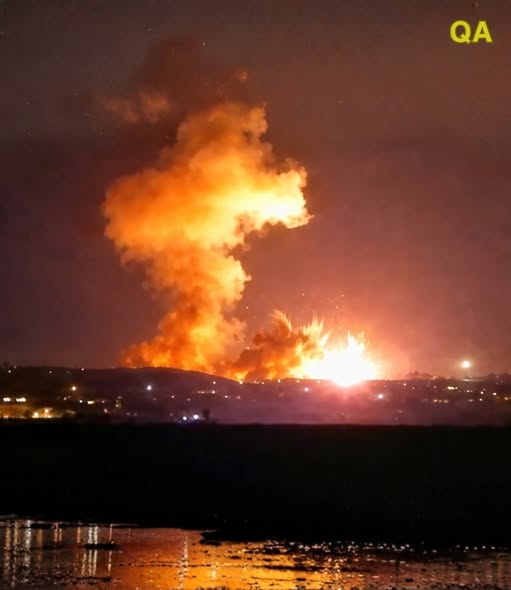
SB. Trump posts clip of massive blast after
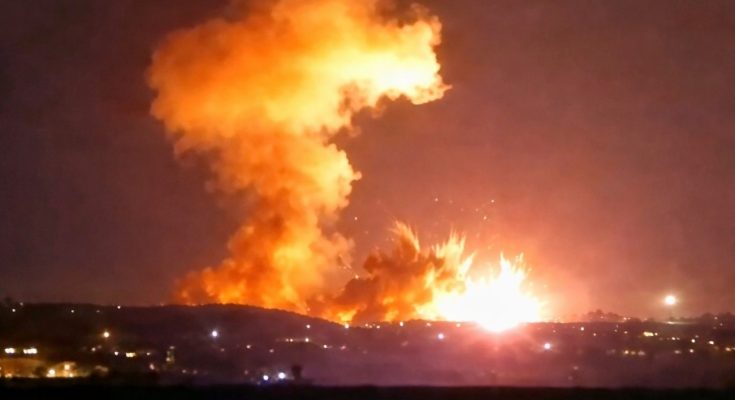
SB. Trump posts clip of massive blast after
The night sky over Isfahan, a city historically celebrated for its turquoise-tiled mosques and ancient bridges, was recently shattered by a spectacle of light and sound that felt less like a modern military operation and more like a scene from a high-budget cinematic thriller. A colossal fireball erupted, casting a haunting, amber glow over the horizon—a visual so potent it was immediately seized upon and shared by President Donald Trump as if it were a trailer for an upcoming blockbuster. Yet, behind the brilliance of that mushroom-shaped cloud lies the grim, complicated reality of a secret conflict that has reached a boiling point, one that no electorate ever formally voted on but which now dictates the rhythm of global security.
As the footage of the Isfahan eruption circulated globally, a flurry of urgent questions followed in its wake. Rumors of bunker-busting technology, the status of sensitive materials, and the structural integrity of underground facilities began to spiral through digital networks. For the residents of the city and the observers in the West, the stakes could not be higher: a metropolis sitting on the edge of a potential regional catastrophe. Meanwhile, the Pentagon remained in a state of calculated silence, leaving the world to hold its collective breath as the dust—both literal and political—began to settle.
The Message in the Fire
The explosion over Isfahan was far more than a spectacular display of kinetic energy; it was a blunt, uncompromising message delivered in fire. For decades, the city has been known to international monitors as a critical hub for high-stakes industrial and technological development. Deep beneath the surface of the Isfahan province lie sprawling complexes and hardened factories—the fortified heart of a regime that has invested heavily in burying its strategic ambitions under layers of reinforced concrete and mountain rock.
When the former president posted the video of the strike, he did more than just share a viral clip. He amplified a signal of massive escalation, broadcasting a moment that official military channels were not yet ready to explain in real time. The act of sharing such footage transformed a covert operation into a public declaration, stripping away the traditional “deniability” that usually accompanies shadow wars in the Middle East. It turned a tactical strike into a political instrument, forcing the international community to confront a reality that is often kept in the shadows.
The Evolution of the Shadow War: From “Midnight Hammer” to “Epic Fury”
To understand the weight of the Isfahan blast, one must look at the sequence of events that led to this moment. Military analysts have begun to piece together a narrative of a sustained campaign, often referred to in intelligence circles by monikers like Operation Epic Fury. This mission appears to be the successor to the previous year’s Midnight Hammer raid—a pattern of high-precision strikes designed to hunt strategic assets where they live.
These “missile cities,” as they are often described, are not mere storage lockers. They are vast, subterranean networks rumored to have been constructed with technical insights or blueprints shared by traditional allies of the regime, including North Korea. These tunnels are designed to withstand conventional aerial bombardment, making the use of specialized, high-yield “bunker-penetrating” munitions almost a necessity for any force seeking to neutralize them.
Each of these raids follows a specific logic: the degradation of a nation’s ability to project power without engaging in a full-scale ground invasion. By targeting the “hardened heart” of the infrastructure, the initiating forces aim to trap an arsenal in shattered tunnels, turning a source of strength into a tomb of twisted metal and rubble. However, as the conflict drives deeper—both literally into the earth and politically into the international discourse—the line between “deterrence” and “disaster” grows terrifyingly thin.
The Pentagon’s Silence and the Digital Echo Chamber
While the video evidence provided a visceral look at the impact, the official response from Washington remained shrouded in ambiguity. The Pentagon’s refusal to provide an immediate play-by-play is a standard tactic in “grey zone” warfare. By maintaining silence, the military preserves its options for future operations and avoids backing the opposing regime into a corner where a face-saving, massive counter-retaliation becomes an absolute necessity.
However, in the age of social media, silence from the center is quickly filled by noise from the fringes. On platforms like Truth Social, X, and Telegram, the vacuum of official information was filled with speculation about the nature of the target.
The Uranium Question: Reports have long suggested that Isfahan is home to facilities capable of processing 60% enriched uranium. If a strike were to hit such a facility, the environmental and humanitarian consequences could be catastrophic.
The Bunker Buster Debate: Analysts scrutinized the shockwave of the blast, debating whether the explosion came from an external missile or a pre-positioned internal sabotage device.
The Drone Factor: Some witnesses reported hearing the distinctive “buzz” of small, low-altitude drones prior to the explosion, suggesting a “swarm” tactic used to overwhelm local air defenses.
The former president’s decision to frame this event as a show of strength highlights a fundamental shift in how modern conflict is perceived. It is no longer just about the physical destruction of a target; it is about the narrative of dominance. In this digital echo chamber, the fireball over Isfahan becomes a symbol of resolve for supporters and a terrifying omen of instability for critics.
The Human and Environmental Stakes
Lost in the high-level talk of “deterrence” and “kinetic strikes” is the reality of the people living in Isfahan. With a population of over two million, the city is a living museum of Persian culture. The prospect of a major industrial or “hardened” site being targeted so close to a civilian center brings with it the risk of collateral damage that goes far beyond shattered glass.
If these underground facilities contain volatile chemical components or sensitive technological materials, a breach of their containment could lead to a localized environmental crisis. The “mushroom cloud” mentioned by observers, while often a characteristic of large-scale conventional explosions in confined spaces, carries a heavy psychological weight. It evokes the ultimate fear of the nuclear age, reminding the world that we are playing a game of chicken with the most dangerous materials on the planet.
Có thể là hình ảnh về ngọn lửa
The Role of International Allies and Global Instability
The Isfahan incident does not happen in a vacuum. It is part of a broader geopolitical chess match involving the United States, Israel, and the regional ambitions of Iran. For Israel, the neutralized threat of a neighboring nation’s long-range capabilities is an existential priority. For the United States, it is a matter of maintaining regional order and preventing the proliferation of advanced weaponry.
However, the reported involvement of North Korean or Chinese engineering in these “missile cities” suggests a much larger, globalized network of defense cooperation. If the tunnels destroyed in Isfahan were built with foreign expertise, the strike is not just an attack on one nation; it is a challenge to the entire bloc that supports it. This creates a “ladder of escalation” where a single fireball in central Iran could trigger a diplomatic or economic response as far away as East Asia.
The Future of “Epic Fury”: Deterrence or Disaster?
As we move further into 2026, the strategy of “active deterrence” via targeted strikes appears to be the new normal. The goal is to keep the conflict “sub-threshold”—large enough to cause significant damage to a military’s capabilities, but small enough to avoid a declaration of total war.
But can such a balance be maintained indefinitely? The lessons of history suggest that every action has an equal and opposite reaction. By driving the conflict deeper into the earth, the initiating forces may be inadvertently creating a more resilient and desperate opponent.
Hardened Resolve: Instead of backing down, the regime may further accelerate its underground construction, moving even deeper into the bedrock.
Asymmetric Response: Unable to match the aerial power of the West, the targeted nation may turn to proxy forces, cyber warfare, or maritime disruption to strike back.
The Risk of Miscalculation: One “stray” munition or one “unlucky” hit on a sensitive site could turn a strategic victory into a humanitarian nightmare, drawing the entire world into a conflict it has been trying to avoid for forty years.
Có thể là hình ảnh về ngọn lửa và văn bản
Conclusion: The World on the Edge
The fireball over Isfahan remains a haunting image of our current era. It represents the intersection of cutting-edge military technology, high-stakes political theater, and the terrifying potential for global catastrophe. When a former world leader shares footage of a clandestine strike like a piece of entertainment, it signals a shift in the moral and political boundaries of warfare.
We are living in the age of the Permanent Secret War. It is a conflict fought in the shadows, broadcast on social media, and paid for in the uncertainty of a world that no longer knows where the next “Epic Fury” will strike. As the satellite flashes continue to illuminate the night sky over the Middle East, the global community must ask itself: are these strikes truly making the world safer, or are they simply lighting the fuse on a much larger, more devastating explosion?
The line between keeping the peace and starting a fire has never been thinner. Somewhere between the “Truth Social” posts and the silent corridors of the Pentagon, the truth of the Isfahan blast resides. It is a truth written in fire, hidden in tunnels, and waiting for the moment when the world finally realizes that we cannot solve the problems of the surface by simply blowing up the world below.
As the dust settles over the ancient city, the questions remain. Was this the final blow to a clandestine program, or just the opening act of a much darker drama? The world holds its breath, waiting for the next flash on the horizon, hoping that the next fireball won’t be the one that finally sets the whole world ablaze.