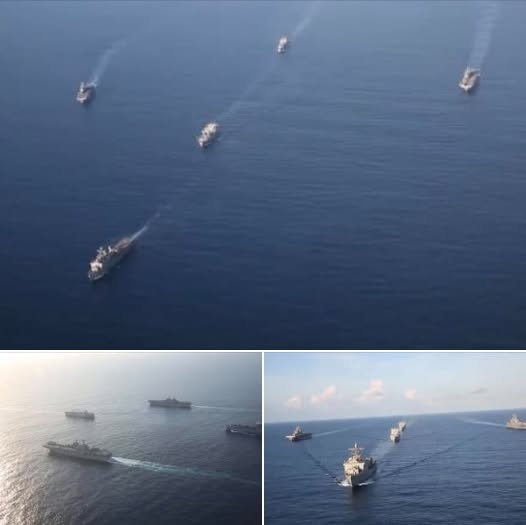
US Navy amphibious assault ships USS Tripoli and USS New Orleans, heavily loaded with approximately 2,200 highly trained and combat-experienced Marines from the 31st Marine Expeditionary Unit, are now moving with deliberate speed and strategic precision directly into U.S. Central Command’s area of responsibility this week, signaling a significant escalation in regional military readiness and forward-deployed deterrence.
These Marines bring a formidable and versatile combat capability to the region — including advanced attack helicopters capable of close air support and rapid strike missions, amphibious landing craft designed for contested shore insertions, and the operational speed and coordination required to launch complex amphibious assaults at a moment’s notice if such orders are given, all while reinforcing powerful carrier strike groups that are already actively engaged in sustained operations targeting Iranian positions as tensions continue to rise.
At the same time, Iran’s leadership continues to keep the strategically vital Strait of Hormuz effectively restricted and under threat, creating a chokehold on one of the world’s most critical النفط transit routes, severely disrupting global oil flows, destabilizing international energy markets, and holding the broader global economy under mounting pressure as shipping lanes face increasing risk and uncertainty.
President Trump has made it unmistakably clear that his administration has zero tolerance for what it views as geopolitical blackmail, and he is now openly considering the possibility of asserting control over Iran’s Kharg Island — a critically important oil export hub through which the overwhelming majority of Iran’s crude oil shipments pass — as part of a broader strategy to neutralize Tehran’s economic leverage and restore stability to global energy supplies.
The broader message being conveyed is one of “peace through overwhelming strength,” as the United States positions highly capable Marine forces in CENTCOM-controlled waters alongside carrier strike groups already on station, creating a layered and credible military posture that signals to Iran that any continued attempts to close the strait, threaten international shipping, or escalate hostilities will be met with serious and potentially decisive consequences.
In this environment, U.S. leadership is framing the situation as a turning point, asserting that the Iranian regime’s long-standing strategy of disruption, coercion, and asymmetric pressure is rapidly losing effectiveness in the face of overwhelming American military presence, and emphasizing that the United States is fully prepared, strategically aligned, and “locked and loaded” to respond to any further provocations with speed, and resolve.