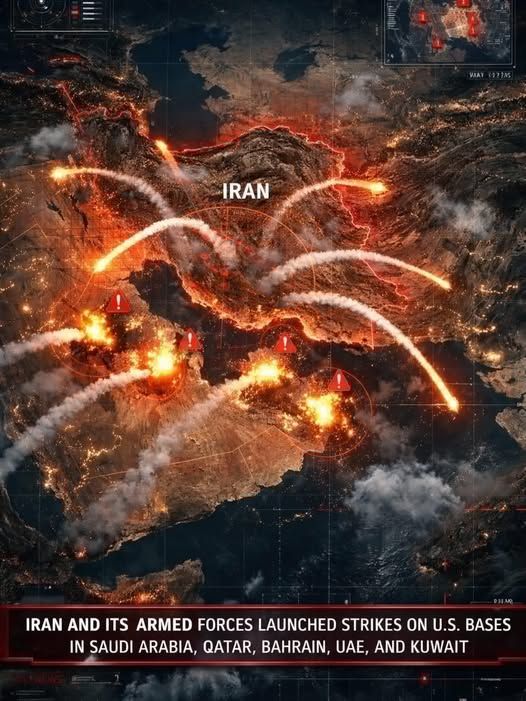
The central focus of the image is a map of the region, with “IRAN” clearly labeled at the center. Bright, fiery missile trails arc outward from Iranian territory toward several surrounding countries, including Saudi Arabia, Qatar, Bahrain, the United Arab Emirates (UAE), and Kuwait. At the bottom, a bold caption reads: “IRAN AND ITS ARMED FORCES LAUNCHED STRIKES ON U.S. BASES IN SAUDI ARABIA, QATAR, BAHRAIN, UAE, AND KUWAIT.” The visual style suggests a dramatic breaking-news or wartime broadcast graphic.
From a compositional standpoint, the image uses strong visual cues to create urgency and intensity. The color palette is dominated by dark tones—deep blacks and browns for land and sea—contrasted sharply with bright reds, oranges, and yellows representing explosions and missile paths. The glowing arcs symbolize ballistic missile trajectories, visually connecting Iran to multiple impact zones. These arcs create a sense of coordinated, simultaneous attacks rather than isolated incidents. The explosion icons and warning symbols placed over the Gulf region reinforce the message of widespread strikes.
The perspective is slightly angled, giving a semi-3D satellite view of the terrain. This gives the image a strategic, command-center feel, as though the viewer is observing military operations from above. The inclusion of grid lines and a small inset map in the upper corner adds to the aesthetic of surveillance or intelligence monitoring. These elements are commonly used in defense briefings or news coverage of armed conflict, which enhances the image’s perceived realism—even though it appears stylized rather than photographic.
Geopolitically, the countries mentioned in the caption are significant because they host U.S. military installations. Qatar is home to Al Udeid Air Base, one of the largest U.S. bases in the region. Bahrain hosts the U.S. Navy’s Fifth Fleet. Kuwait and the UAE also serve as strategic military and logistical hubs, while Saudi Arabia has hosted various U.S. forces over time. By highlighting these specific countries, the graphic frames the scenario as a major regional escalation rather than a limited bilateral conflict.
The message conveyed by the image is one of large-scale retaliation or preemptive action by Iran. However, there are no visible timestamps, verified sources, or official logos that would confirm it as a genuine news broadcast. The dramatic visual style suggests it may be speculative, propagandistic, or designed to provoke emotional reactions. The intense flames, repeated explosion markers, and urgent typography contribute to a sense of crisis and alarm.
Emotionally, the image is constructed to evoke fear and urgency. The repeated use of fire and smoke conveys destruction and chaos. The missile arcs are exaggerated and numerous, suggesting overwhelming force. The warning icons—red triangles with exclamation marks—visually amplify the sense of danger. This combination of visual elements can influence viewers’ perceptions by making the scenario appear immediate and catastrophic.
From an informational standpoint, the image does not provide evidence or supporting data. It is a visual narrative rather than a factual report. Without corroboration from reliable news sources, it should not be interpreted as confirmation of real events. In modern information environments, such graphics are often shared on social media to dramatize geopolitical tensions or spread unverified claims.
In summary, this image is a dramatic, stylized representation of a hypothetical or reported military action by Iran against U.S. bases in the Gulf region. It uses strong visual symbolism—missile arcs, explosions, warning icons, and a strategic map perspective—to convey large-scale coordinated strikes. While it references real geopolitical relationships and military infrastructure, the image itself functions more as a visual narrative or propaganda-style graphic than as documented evidence. Careful verification from credible news outlets would be necessary before treating its claims as factual.