The rain began before dawn.
It slid down the cracked windows of the military transport bus in silver rivers, blurring the empty roads into streaks of gray. Sergeant Elias Mercer sat alone near the back, his duffel bag resting beside his boots, his hands folded together so tightly that the knuckles had turned pale.
Two years.
Seven hundred and thirty-one days since he had last seen his wife.
Seven hundred and thirty-one nights since he had kissed his daughter goodnight.
The war had taken many things from him.
Sleep.
Friends.
Pieces of himself he could no longer name.
But through every explosion, every freezing night in the desert, every gunshot that echoed too close to his heartbeat, one thought had carried him forward:
Home.
Home was supposed to remain untouched.
Home was supposed to wait.
Elias stared at the wedding ring still hanging from the chain around his neck.
He had stopped wearing it on his finger months ago after nearly losing it during a firefight. But he never removed it completely. Even when blood covered his uniform. Even when death walked beside him like an old friend.
The bus slowed near the city limits.
Morning light crept slowly over the horizon.
His hometown looked smaller than he remembered.
Quieter.
Like life had moved on without asking permission.
He swallowed hard.
In his pocket was a folded letter he had written three nights earlier.
If something happens to me before I get home, tell Clara I never stopped trying.
But nothing had happened.
He survived.
And now he was finally coming back.
He imagined Clara opening the front door.
Her face breaking into tears.
Their daughter Lily running toward him.
The kind of reunion soldiers dream about when the world becomes unbearable.
Elias closed his eyes.
He held onto that image the way drowning men hold onto air.
He did not know yet that some wars continue long after the battlefield is left behind.
Chapter One
Two Years Earlier
The night before deployment smelled like coffee and heartbreak.
Clara stood in the kitchen pretending to clean dishes that were already spotless. Elias watched her from the doorway while Lily slept upstairs.
Neither of them wanted to talk about tomorrow.
Tomorrow meant goodbye.
Tomorrow meant uncertainty.
Tomorrow meant another war that politicians would discuss from safe rooms while ordinary men carried rifles through hell.
“You packed everything?” Clara asked quietly.
“Yeah.”
“You always forget socks.”
A small smile touched his face.
“Packed extra this time.”
She nodded without looking at him.
Silence stretched between them.
Elias crossed the room slowly.
“You’re angry.”
“I’m scared.”
Her voice cracked on the last word.
That hurt him more than shouting ever could.
Clara finally turned toward him.
She was still beautiful in the soft yellow kitchen light. Chestnut hair tied loosely back. Tired eyes. The face of a woman trying to stay strong for everyone else.
“You said the last deployment would be the final one.”
“I know.”
“And now it’s another year.”
“Maybe less.”
“You don’t know that.”
No.
He didn’t.
The truth sat heavy between them.
Soldiers learned quickly that promises were fragile things.
Elias stepped closer.
“I have to go.”
“You always have to go.”
The sentence came out sharper than she intended.
Immediately regret flashed across her face.
“I didn’t mean—”
“No,” Elias said softly. “You did.”
Clara covered her face for a moment.
“I hate feeling like the army owns more of you than I do.”
He wrapped his arms around her.
For a long time she simply stood there.
Then she broke.
Her shoulders shook as she cried quietly into his chest.
Elias held her tighter.
“I’ll come back.”
“You can’t promise that.”
“I can promise I’ll try.”
She pulled away enough to look at him.
“Do you know what scares me most?”
“What?”
“That one day you’ll come home and we won’t know each other anymore.”
Elias kissed her forehead.
“That could never happen.”
But life has a cruel sense of irony.
Sometimes the things we fear most arrive slowly, quietly, until one day they are standing at the front door.
Chapter Two
War changes time.
Days become endless.
Months disappear.
The first six weeks overseas passed in dust, exhaustion, and adrenaline.
Elias learned the names of the men in his unit quickly because in war you either learn fast or bury people faster.
Corporal Ben Carter laughed too loudly.
Ramirez carried photographs of twin boys in his vest.
Young Mason lied about his age to enlist.
Every soldier carried something fragile inside them.
Some carried faith.
Some carried guilt.
Some carried memories.
Elias carried Clara’s final hug.
At first, the letters came regularly.
Clara wrote about Lily losing her first tooth.
About the garden dying in the summer heat.
About missing him so much it physically hurt.
Elias reread those letters until the paper softened at the edges.
Then the replies became slower.
Weeks apart.
Then months.
Communication lines failed often in combat zones. Elias told himself that was all it was.
Until one night, during a rare moment of internet access, he finally received a message.
I’m trying, Elias. I really am. But everything feels so heavy now.
That sentence haunted him.
Heavy.
He stared at the screen for hours.
He typed dozens of responses before deleting them.
What comfort could a man offer from thousands of miles away while carrying a rifle?
Three weeks later, his convoy was ambushed.
The explosion flipped the lead vehicle onto its side.
Gunfire erupted instantly.
Chaos swallowed everything.
Elias remembered dirt in his mouth.
Smoke.
Screaming.
Ramirez collapsing beside him.
The terrible realization that death does not arrive dramatically.
It arrives suddenly.
Carelessly.
Like a door slamming shut.
Afterward, while medics carried bodies into helicopters, Elias sat alone behind a ruined wall and stared at blood on his hands.
Not his own.
He thought about Clara.
About Lily.
About how fragile life truly was.
That night he wrote another letter.
If I survive this war, I swear I’ll never leave you again.
But the letter never reached home.
The supply truck carrying outgoing mail was destroyed two days later.
And somewhere far away, Clara waited beside a silent phone, believing she was slowly being forgotten.
Chapter Three
Loneliness changes people.
Not all at once.
Not dramatically.
It happens quietly.
Like winter settling over a field.
Clara tried to stay strong.
For Lily.
For herself.
For the marriage she still believed in.
But bills kept arriving.
The washing machine broke.
Lily developed nightmares.
The house felt colder every month.
Neighbors stopped checking in.
Friends slowly disappeared back into their own lives.
People often praise military spouses for their strength.
What they rarely mention is the exhaustion.
The endless waiting.
The fear every time the phone rings late at night.
One evening, while struggling to carry groceries through the rain, Clara met Nathan Holloway.
He lived three houses away.
Recently divorced.
Quiet.
Kind.
He helped her carry the bags inside.
That was all.
At first.
Weeks passed.
Nathan began mowing her lawn when Elias couldn’t.
Fixing small things around the house.
Helping Lily with homework.
Nothing inappropriate.
Nothing dramatic.
Just presence.
And presence can become dangerously comforting when someone else is absent for too long.
Clara fought the guilt constantly.
Every laugh with Nathan felt like betrayal.
Every moment of relief felt wrong.
But human beings are not built to survive endless emotional winters alone.
One night Lily asked quietly:
“Is Daddy coming back?”
Clara froze.
“Yes.”
“When?”
“I don’t know.”
Lily looked down.
“I barely remember his voice.”
That sentence shattered something inside her.
Later that night Clara sat alone at the kitchen table crying silently while Nathan repaired the broken porch light outside.
He noticed her tears when he came in.
“You okay?”
“No.”
He hesitated.
Then sat across from her.
And for the first time in months, someone listened.
Not through static-filled calls.
Not through delayed letters.
But physically.
Right there.
That was the beginning.
Not love.
Not betrayal.
Just two lonely people sitting in the same silence.
Sometimes that is enough to change everything.
Chapter Four
Elias almost died during the second winter overseas.
A sniper round struck the wall inches from his head.
Concrete exploded across his face.
For several terrifying seconds he believed he had been shot.
Afterward he sat trembling behind cover while bullets cracked through the streets around them.
Fear does strange things to pride.
That night he called home despite terrible connection quality.
Clara answered after three rings.
For a moment neither spoke.
Then hearing her voice again nearly broke him.
“Clara.”
Static crackled.
“Oh my God… Elias?”
“I’m here.”
Her breathing became uneven.
“You disappeared for three months.”
“I know. Communications—”
“I thought you were dead.”
Pain flooded her voice.
He closed his eyes.
“I’m sorry.”
Lily shouted in the background.
“Mom? Is it Daddy?”
Elias smiled through tears.
“Put her on.”
For ten precious minutes he listened to his daughter talk about school, cartoons, and losing another tooth.
He memorized every sound.
Every laugh.
Then the connection began failing again.
“Daddy?” Lily asked. “When are you coming home?”
“Soon.”
A lie.
Necessary.
But still a lie.
Before the line cut completely, Clara spoke softly.
“I don’t know how much longer I can do this.”
Then silence.
Elias stared at the dead phone.
Outside, distant gunfire echoed through the darkness.
Inside, a different kind of fear took root.
Chapter Five
By the time Elias finally returned home, the war had already stolen too much.
The taxi stopped in front of the house shortly after noon.
He stared at it for several long seconds.
Fresh paint.
Different curtains.
A bicycle he didn’t recognize leaning against the porch.
Something inside him tightened.
Still, hope pushed him forward.
He stepped out carrying his duffel bag.
His heart pounded harder with every step toward the front door.
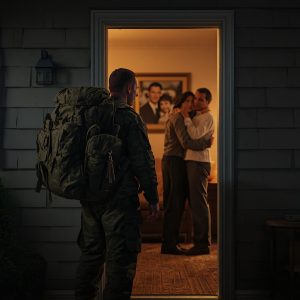
Then he noticed the second car in the driveway.
A man’s jacket hanging beside the entrance.
Elias knocked.
Footsteps approached.
The door opened.
And the world changed.
Clara stood frozen.
The color drained from her face.
For one impossible moment neither moved.
Elias smiled weakly.
“Hey.”
She covered her mouth.
“Oh my God.”
Behind her, a man appeared carrying a coffee mug.
Nathan.
He stopped immediately.
The silence that followed felt unbearable.
Elias looked from Nathan… to Clara… to the wedding ring no longer on her hand.
And suddenly he understood.
Not completely.
But enough.
Pain moved across his face slowly.
Like something physically breaking.
Clara began crying instantly.
“Elias, I can explain—”
“When?” he asked quietly.
The softness in his voice hurt more than rage would have.
She struggled to speak.
“We thought…”
“You thought what?”
Nathan stepped forward carefully.
“She believed you were gone.”
Elias looked at him.
Not with hatred.
Just exhaustion.
“Who are you?”
“Nathan.”
Clara’s tears fell harder.
“We got married six months ago.”
The sentence landed like a bullet.
Elias stared at her.
Two years surviving bombs.
Gunfire.
Death.
Only to discover the real destruction had happened at home.
Then small footsteps thundered down the stairs.
Lily appeared.
Eight years old now.
Taller.
Older.
She stopped at the sight of him.
Confusion crossed her face.
Then recognition.
“Daddy?”
Elias dropped the duffel bag.
Lily ran into his arms.
And for the first time since returning home, he cried.
Chapter Six
That evening shattered everyone differently.
Lily refused to let go of Elias.
She clung to him as though afraid he would disappear again.
Clara watched from across the room, drowning in guilt.
Nathan stood near the kitchen window like a man who suddenly realized he had walked into someone else’s unfinished story.
No one knew what to say.
Finally Elias spoke.
“Did you ever try finding me?”
Clara looked down.
“They told us your unit disappeared during the attack.”
“We were relocated.”
“They said there were casualties.”
“There were.”
Silence.
Elias rubbed his tired eyes.
“I wrote letters.”
“I never got them.”
“I called when I could.”
“You disappeared for months at a time.”
Pain cracked through her voice.
“You have no idea what it was like.”
Something hardened briefly in Elias’s expression.
“And you think I do?”
The room fell quiet again.
Because suffering is not a competition.
Both of them had been drowning.
Just in different oceans.
Nathan finally spoke.
“I should leave.”
Clara turned quickly.
“Nathan—”
“No.” He shook his head gently. “You need to talk.”
He looked at Elias.
For a moment the two men simply stared at each other.
Then Nathan said quietly:
“I never meant to replace you.”
Elias answered honestly.
“But you did.”
Nathan left shortly after.
The house became unbearably still.
Late that night, after Lily finally fell asleep curled beside him on the couch, Clara approached carefully.
Elias sat staring into darkness.
“You hate me,” she whispered.
“No.”
That surprised her.
“I don’t think I have enough energy left for hate.”
She sat down slowly.
“I waited as long as I could.”
“I know.”
“I thought you were dead.”
“I know.”
Tears streamed down her face.
“I never wanted this to happen.”
Elias finally looked at her.
War had changed him.
There was an exhaustion in his eyes deeper than anger.
“Neither did I.”
Chapter Seven
The following weeks felt like living inside broken glass.
Every conversation cut somebody.
Lily wanted her parents together again.
Clara wanted forgiveness she wasn’t sure she deserved.
Nathan wanted to disappear from the disaster entirely.
And Elias…
Elias no longer knew what he wanted.
He rented a small apartment near the edge of town.
Sparse furniture.
Thin walls.
A bed that creaked every time he moved.
At night he woke from nightmares soaked in sweat.
Sometimes he reached instinctively for Clara before remembering she belonged to another life now.
One evening Lily asked him quietly:
“Are you coming home for real?”
Elias struggled to answer.
Because technically… there was no home anymore.
Children notice pain faster than adults realize.
Lily touched his hand.
“Mom cries a lot now.”
He swallowed hard.
“So do I.”
Meanwhile Clara’s marriage to Nathan began unraveling under the weight of guilt.
Nathan was not a cruel man.
In truth, he had loved both Clara and Lily sincerely.
But love built on grief often collapses once the missing person returns.
One night Nathan sat alone on the porch while Clara stood nearby.
“You still love him.”
She closed her eyes.
“I don’t know.”
“Yes, you do.”
“I loved you too.”
Nathan laughed sadly.
“That’s the problem.”
He looked toward the dark street.
“I spent two years trying to heal your loneliness. But I think part of your heart never stopped waiting for him.”
Clara began crying again.
“I didn’t mean to hurt anyone.”
“I know.”
Nathan stood slowly.
“But meaning well doesn’t protect people from pain.”
That sentence stayed with her long after he walked inside.
Chapter Eight
Months passed.
Autumn arrived.
Leaves drifted across sidewalks like fading memories.
Elias started working construction during the day.
Physical exhaustion helped quiet his mind.
Sometimes.
Other times nothing helped.
He struggled to reconnect with ordinary life.
Crowded stores made him anxious.
Fireworks sent panic through his body.
Loud noises dragged him back into war instantly.
One afternoon at a grocery store, a stack of metal cans crashed nearby.
Elias hit the floor before realizing where he was.
People stared.
Embarrassment burned through him.
That night he sat alone in his apartment staring at old family photographs.
He barely recognized himself.
The man smiling beside Clara looked lighter.
Safer.
Still capable of believing life was simple.
A knock came at the door.
Clara stood outside.
Cold wind lifted strands of her hair.
“I shouldn’t be here,” she said immediately.
“But you are.”
She looked exhausted.
“Nathan moved out.”
Elias said nothing.
“I keep thinking if I explain things enough, maybe it’ll hurt less.”
“It won’t.”
Her eyes filled with tears.
“I waited fourteen months before I even looked at another man.”
He nodded quietly.
“I know.”
“I was drowning, Elias.”
“So was I.”
They stood facing each other in silence.
Then Clara whispered:
“Do you still love me?”
The question destroyed him.
Because the answer was yes.
And that made everything infinitely harder.
Finally he said:
“Love isn’t always enough to repair what’s broken.”
Clara cried openly.
“I would undo everything if I could.”
Elias believed her.
That was the tragedy.
Sometimes people make irreversible decisions while simply trying to survive.
Chapter Nine
Winter came early that year.
Snow covered the town in silence.
Elias spent Christmas morning with Lily.
They built pancakes badly.
Watched old movies.
Laughed harder than either expected.
For a few precious hours life felt almost normal.
Then Lily asked:
“Why can’t you and Mom be together again?”
Children often ask questions adults spend years avoiding.
Elias looked at the small Christmas tree glowing in the corner.
“Because sometimes people hurt each other too deeply.”
“But you still love her.”
He stared at his daughter.
“How do you know that?”
“She still looks at you the same way.”
Pain touched his face.
Children notice everything.
That evening Clara arrived to pick Lily up.
Snow fell gently outside.
For a moment the three of them stood together beneath warm yellow lights like a family trapped inside memory.
Clara looked around the apartment.
“You decorated.”
“Lily insisted.”
A faint smile appeared.
Then disappeared.
As Lily grabbed her coat upstairs, Clara spoke softly.
“I miss us.”
Elias closed his eyes briefly.
“So do I.”
“Then why are we doing this?”
He looked at her carefully.
“Because if I come back now, eventually I’ll wonder whether you stayed because you truly chose me… or because guilt pushed you back.”
“That’s not fair.”
“Neither was losing my family while trying to stay alive overseas.”
The words slipped out harsher than intended.
Immediately regret crossed his face.
But the damage was done.
Clara stepped back like she had been struck.
Lily returned before either could speak again.
And another conversation died unfinished.
Chapter Ten
Healing rarely happens dramatically.
There is no single sunrise where pain disappears.
No speech powerful enough to erase regret.
Life simply continues.
Slowly.
Relentlessly.
Elias began attending therapy sessions for veterans.
At first he hated them.
Sitting in circles discussing trauma felt impossible.
But over time he realized something important:
Pain spoken aloud loses some of its power.
One elderly veteran named Thomas told him:
“War teaches men how to survive. It doesn’t teach them how to return.”
That sentence stayed with Elias.
Because coming home had proven harder than combat itself.
Meanwhile Clara tried rebuilding her life too.
She found work at the local library.
Spent more time with Lily.
Stopped trying to force conversations with Elias.
Some wounds need space before they can breathe.
One spring afternoon nearly a year after his return, Elias visited the cemetery where several soldiers from his unit had been buried.
He stood before Ramirez’s grave for a long time.
“You know what’s strange?” he murmured.
“I survived everything over there. But I still lost the life I was fighting for.”
Wind moved softly through the trees.
No answer came.
But somehow speaking the truth aloud helped.
On the drive home he realized something quietly devastating:
He could spend the rest of his life trapped inside bitterness.
Or he could let go.
Not because what happened was acceptable.
Not because the pain disappeared.
But because carrying grief forever only extends the war.
And he was tired of fighting.
Chapter Eleven
The final conversation happened in early summer.
Clara invited Elias to the lake where they once spent weekends before marriage.
The water reflected gold beneath the setting sun.
For several minutes neither spoke.
Then Clara finally whispered:
“I kept hoping time would fix this.”
Elias looked across the water.
“Time fixes very little by itself.”
Tears filled her eyes.
“I ruined everything.”
“No.”
She stared at him.
“I did.”
He shook his head slowly.
“War ruined things. Distance ruined things. Fear ruined things. Loneliness ruined things. We were just human enough to break underneath all of it.”
Clara cried quietly.
“I should’ve waited longer.”
“Maybe.”
“I should’ve believed you’d come back.”
“Maybe.”
He turned toward her.
“But if you spend your entire life replaying your mistakes, you’ll never survive them.”
She looked shattered.
“I still love you.”
The honesty in her voice hurt.
Because he believed that too.
Elias reached into his pocket.
He removed the wedding ring hanging from the chain around his neck.
For years it had represented hope.
Then grief.
Then anger.
Now it simply represented a life that no longer existed.
He placed it gently in Clara’s hand.
She stared at it in horror.
“No…”
“I can’t keep carrying this.”
Her breathing became uneven.
“Please don’t walk away.”
Elias’s eyes filled with tears for the first time in months.
“I already lost myself once in war.”
His voice trembled.
“I won’t lose what’s left trying to rebuild a ghost.”
Clara broke completely.
She covered her face while sobs shook through her body.
Elias stood there silently.
Still loving her.
Still hurting.
But finally understanding something important:
Love sometimes means accepting that the past cannot be restored.
After a long moment, he stepped backward.
Then turned away.
And walked.
Clara watched him disappear down the shoreline until sunset swallowed his silhouette completely.
That was the last time she ever asked him to come back.
Epilogue
Five years later.
The world continued.
Because it always does.
Lily grew taller.
Older.
Wiser.
Elias eventually moved to another city near the coast.
He worked with struggling veterans.
Helped men who returned home carrying invisible wars inside them.
People often described him as calm.
Gentle.
But those who looked closely noticed sadness lingering quietly behind his smile.
Some grief never fully leaves.
It simply becomes lighter to carry.
Clara never remarried.
Not because she believed punishment would undo the past.
But because she finally understood something too late:
Love is not measured only by presence.
Sometimes love is measured by endurance.
By loyalty during uncertainty.
By choosing faith when fear would be easier.
On Lily’s graduation day, Elias and Clara sat several seats apart beneath warm sunlight.
Their eyes met briefly.
No anger remained.
Only history.
And understanding.
After the ceremony Lily hugged both of them tightly.
“You know,” she said softly, “you two taught me something important.”
Elias smiled faintly.
“What’s that?”
“That love alone doesn’t save relationships.”
Clara looked down.
Lily continued:
“Trust does. Patience does. Sacrifice does. Forgiveness does.”
Silence settled over them.
Then Lily smiled sadly.
“And sometimes people only realize what mattered after it’s gone.”
The words landed gently.
Not as accusation.
But truth.
Later that evening Elias walked alone beside the ocean.
Waves crashed softly against the shore.
The wind smelled like salt and memory.
For years he believed life had stolen everything from him.
But standing there beneath the fading sky, he finally understood the deeper lesson hidden inside his pain:
People cannot always control what happens to them.
But they can control what pain turns them into.
Bitterness or wisdom.
Cruelty or compassion.
Endless war… or peace.
Elias chose peace.
And sometimes that is the bravest thing a wounded person can do.
Moral of the Story
Life tests people in ways they never expect.
Distance can weaken love.
Loneliness can cloud judgment.
Fear can push good people into painful decisions.
But the deepest lesson is this:
Never make permanent choices based on temporary despair.
And never assume that surviving hardship gives permission to stop valuing loyalty, patience, and communication.
Some people spend years fighting battles just to return home to silence.
Others discover too late that comfort is not the same as true commitment.
In the end, regret often comes not from failing to be loved…
But from failing to protect the love we already had.
And sometimes the strongest people are not the ones who win every battle.
They are the ones who walk away from bitterness even after life breaks their heart.