For years, silence had been the loudest thing in my life.
Not the peaceful kind of silence people write poems about. Mine was heavier. It lived in hospital hallways, empty bedrooms, and the long pauses people gave before speaking to me, as if they were afraid the wrong words might break me completely.
It began when I was ten years old.
Before the fire, my world had been ordinary in the best possible way. My father fixed cars in our small town garage, always coming home smelling faintly of oil and cedarwood soap. My mother taught music lessons from the living room, filling our house with piano melodies that drifted through the windows every evening.
And me?
I ran everywhere.
I climbed trees behind our house, raced bikes with neighborhood kids, and danced barefoot in the kitchen while my mother played old records on rainy days. I thought life would always sound like laughter echoing through warm rooms.
Then came the fire.
Even now, years later, certain smells still carried me back there instantly. Smoke. Burned wood. Gasoline.
That night had started quietly.
I remembered waking to shouting.
Then heat.
Then darkness.
The fire spread too quickly for anyone to stop it.
My father managed to reach my bedroom before the ceiling collapsed, but by then the flames had already trapped us. I remembered his arms around me. His voice telling me not to look back. The unbearable heat against my skin.
And then—
Nothing.
When I woke in the hospital days later, everything had changed.
My parents were gone.
And I would never walk again.
The doctors explained it gently, but no gentle explanation can soften a sentence that destroys a child’s future.
At first, I believed they were wrong.
I spent months waiting to feel my legs again.
Months staring at toes that no longer moved no matter how desperately I begged them to.
Eventually, reality settled over me slowly and painfully.
The wheelchair became permanent.
And after that, people changed.
Not cruelly.
That almost would have been easier.
Instead, people became careful.
Teachers spoke softer around me. Friends stopped inviting me certain places because they assumed it would be difficult. Adults smiled with pity in their eyes. Strangers either stared too long or avoided looking at me completely.
Everywhere I went, I could feel the difference.
I was no longer simply Emma.
I was “the girl in the wheelchair.”
Over time, loneliness became familiar.
By high school, I had learned how to disappear quietly inside crowded rooms. I mastered polite smiles. Learned how to pretend not to notice whispers. Learned how to act comfortable when people spoke to whoever pushed my chair instead of speaking directly to me.
The hardest part wasn’t the chair itself.
It was feeling invisible inside it.
That was why I almost didn’t attend prom.
The ticket sat untouched on my desk for weeks while I debated throwing it away. Everyone else seemed excited about dresses, dates, and after-parties. Meanwhile, I kept imagining awkward stares and sympathetic smiles.
But a small part of me—some stubborn piece I thought the fire had destroyed—wanted one normal night.
Just one.
So I went.
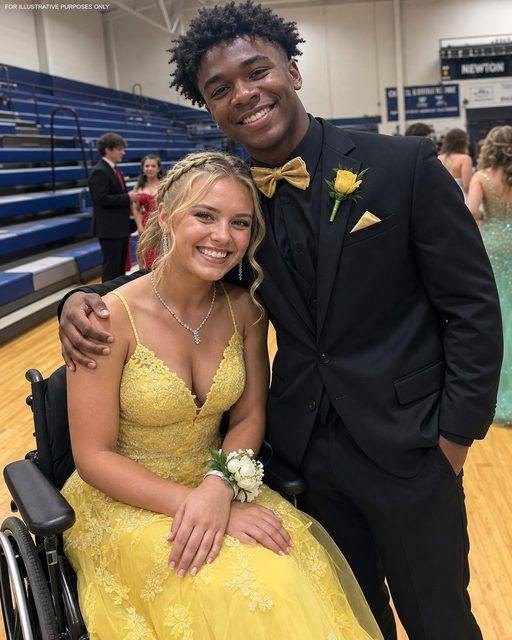
My aunt helped me into a soft golden dress that shimmered beneath the light. She cried quietly while braiding my hair, though she tried to hide it.
“You look beautiful,” she whispered.
I smiled for her sake.
But inside, fear twisted tightly in my chest.
The gymnasium looked magical when we arrived. Strings of lights hung from the ceiling like stars. Music pulsed through the room while students laughed beneath spinning colors.
Everyone looked alive.
Free.
I stayed near the wall most of the night.
Watching.
That had become my habit over the years—watching life instead of participating in it.
Couples danced beneath the lights while groups of friends crowded photo booths and snack tables. Every now and then someone waved politely at me before quickly returning to their own world.
I told myself I didn’t mind.
But I did.
More than I admitted.
I remember lowering my eyes to my hands, wondering if this was simply how life would always feel now: close enough to happiness to see it clearly, but never fully inside it.
Then a voice interrupted my thoughts.
“Hey.”
I looked up.
A tall boy stood beside me wearing a black suit with a gold bow tie slightly crooked beneath his smile. His name was Daniel Carter.
Everyone knew Daniel.
Star basketball player.
Honor student.
The kind of person who seemed naturally comfortable everywhere.
But unlike most people, he wasn’t looking at the wheelchair.
He was looking directly at me.
“You’ve been hiding over here all night,” he said gently.
I laughed awkwardly.
“I’m pretty good at that.”
“Well,” he said, offering his hand, “I was hoping you’d dance with me.”
For a moment, I genuinely thought he must be joking.
But his expression never changed.
“You mean… dance?” I asked quietly.
“Yeah,” he said. “Dance.”
The music slowed around us.
The gym lights softened into gold and blue across the floor.
Carefully, Daniel moved beside my wheelchair and guided me toward the center of the room. Not dramatically. Not for attention. Just naturally, as though there was nothing unusual about it at all.
At first, everyone stared.
I felt it instantly.
That familiar heat of being watched.
But Daniel didn’t seem to notice.
Or maybe he simply didn’t care.
He moved slowly with the music, guiding my wheelchair gently across the floor while talking casually about school, teachers, and terrible cafeteria food.
And something strange happened.
I started laughing.
Real laughing.
Not the polite kind.
For the first time in years, I stopped thinking about how I looked or what people saw when they looked at me.
I simply existed in the moment.
The music wrapped around us while lights blurred softly overhead. Students who had been staring before slowly returned to dancing themselves. The room shifted somehow.
The wheelchair stopped being the center of attention.
I did.
At one point Daniel spun my chair carefully beneath the lights, and I laughed so hard tears filled my eyes.
“You okay?” he asked smiling.
“I forgot what this feels like,” I admitted softly.
“What?”
“Feeling normal.”
Daniel’s smile faded slightly.
“You are normal, Emma.”
Nobody had ever said it like that before.
Not with pity.
Not carefully.
Just honestly.
When the song ended, applause unexpectedly rippled through parts of the gym. Embarrassed, I lowered my head, but Daniel leaned closer.
“I’ve wanted to ask you to dance for a long time,” he admitted.
I blinked in surprise.
“What?”
Before he could answer, the gym doors suddenly opened.
A police officer entered.
The music slowly faded.
At first, I assumed it was unrelated to me.
Then the officer walked directly toward us.
His expression was serious but not unkind.
“Emma Williams?” he asked gently.
My stomach tightened.
“Yes?”
“There’s something we need to discuss regarding the fire that killed your parents.”
The room seemed to disappear around me.
Everything became silent.
Even my heartbeat felt distant.
“What do you mean?” I whispered.
The officer glanced briefly toward the principal standing nervously nearby.
“We recently reopened the investigation.”
My hands began shaking.
“For years,” he continued carefully, “everyone believed the fire was caused by faulty wiring.”
“That’s what happened,” I said immediately.
But the officer hesitated.
“No,” he said quietly. “It wasn’t.”
The words hit like ice water.
The gym blurred around me.
Daniel crouched beside my wheelchair instantly.
“Emma,” he said softly, “breathe.”
But I barely heard him.
The officer continued carefully.
“A witness recently came forward with information. Evidence suggests the fire may have been intentionally started.”
My chest tightened painfully.
“Intentionally?” I whispered.
The officer nodded slowly.
“And there’s another reason we came tonight.”
He paused.
“Your father may not have been the target.”
Everything inside me stopped.
“What?”
The officer lowered his eyes briefly.
“We believe your mother was.”
The world tilted.
My mother.
The woman who played piano while cooking dinner.
The woman who kissed my forehead every night before bed.
Who could possibly want to hurt her?
Tears blurred my vision instantly.
Daniel placed a steady hand gently over mine.
“You don’t have to go through this alone,” he whispered.
And somehow, in the middle of that shattered moment, I believed him.
That night changed everything.
Over the following weeks, truths buried for years slowly emerged.
My mother had witnessed financial crimes involving a powerful local businessman named Richard Vane years before the fire. She had planned to testify anonymously after gathering evidence against him.
But somehow, someone discovered what she knew.
The fire had not been an accident.
It had been a warning that went horribly wrong.
The revelation devastated me.
For years, I had tortured myself wondering if somehow surviving when my parents didn’t meant I had failed them.
Now I discovered they were victims of something darker entirely.
Anger consumed me at first.
Then grief returned all over again.
Daniel stayed through all of it.
Hospital visits.
Court hearings.
Panic attacks.
Nightmares.
He never treated me like something fragile needing protection. Instead, he listened. Sometimes for hours.
One afternoon, months later, we sat beside the lake near town while sunlight shimmered across the water.
“I used to think my life ended in that fire,” I admitted quietly.
Daniel looked toward me carefully.
“And now?”
I watched the wind ripple gently through the trees.
“Now I think maybe it just changed.”
He smiled softly.
“That’s different.”
“Yeah,” I whispered. “It is.”
The investigation eventually led to arrests.
Justice came slowly, imperfectly, painfully.
Nothing could bring my parents back.
Nothing could erase the years I spent trapped inside loneliness and fear.
But healing, I learned, does not mean forgetting pain.
Healing means learning your pain is not the end of your story.
Years later, people still remembered the dance at prom.
Not because it was dramatic.
Not because it was perfect.
But because for a few minutes, an entire room witnessed something simple and powerful:
A person being truly seen.
Not as broken.
Not as tragic.
Just human.
Daniel once told me something I never forgot.
“The world changes,” he said, “when people choose kindness even when nobody asks them to.”
I think he was right.
Because one small act of kindness can interrupt years of loneliness.
One moment of courage can restore hope someone thought was gone forever.
And one person choosing to stay beside another person during darkness can change both lives completely.
Moral Lessons From the Story
1. People are more than their pain
A tragedy may change someone’s life, but it does not define their worth or identity.
2. Kindness has enormous power
Daniel’s simple decision to ask Emma to dance changed how she saw herself and how others saw her too.
3. Never judge someone by appearance or disability
Every person deserves dignity, inclusion, friendship, and love.
4. Healing takes time
Trauma does not disappear quickly, but support and understanding can help people rebuild their lives.
5. Courage is often quiet
Emma’s decision to attend prom despite fear was an act of bravery.
6. Small moments matter
A single dance became a turning point neither Emma nor Daniel would ever forget.
7. Love and friendship can restore hope
Sometimes the people who help heal us enter our lives unexpectedly.
8. Truth eventually comes to light
Even painful truths deserve to be uncovered because honesty creates justice and healing.
9. Everyone wants to feel seen
One of the deepest human needs is to feel accepted exactly as we are.
10. Your story is not over after tragedy
Pain may shape your journey, but it does not decide your future.