Evelyn Harper believed she knew every corner of her husband’s heart.
After sixty-five years of marriage, she thought there were no mysteries left between them. At eighty-six, life had become wonderfully ordinary—quiet breakfasts, afternoon naps, old movies playing too loudly in the living room, and Martin pretending not to hear her complain about his terrible habit of leaving teacups everywhere.
Their love was not the kind people wrote songs about anymore. It was softer than that. Deeper. Built from decades of surviving life together.
But love, Evelyn would learn, can still hold secrets even after a lifetime.
And sometimes the secrets are not about betrayal.
Sometimes they are about sorrow.
Sometimes they are about guilt.
And sometimes they are about love so complicated that it leaves scars on everyone involved.
The morning everything changed began with rain.
Soft, silver rain tapped against the windows of their old farmhouse while Evelyn folded laundry in the bedroom upstairs. Martin had been gone for six months already. Even now, saying the words in her mind felt unreal.
Gone.
Dead.
The doctors called it peaceful. Evelyn thought there was nothing peaceful about waking up alone after sixty-five years beside the same person.
Her daughter, Clara, stood in the doorway holding a cardboard box.
“Mom,” she said gently, “we should probably go through Dad’s desk today.”
Evelyn sighed.
Martin’s office had remained untouched since the funeral. Dust gathered on his bookshelves. His glasses still rested beside the lamp. Even his old sweater hung over the chair as if he might walk back into the room and ask where she had hidden the sugar cookies.
“I’m not ready,” Evelyn whispered.
“You may never be.”
Clara crossed the room and squeezed her mother’s hand.
“But we can do it together.”
So they did.
Martin’s office smelled like cedar wood and old paper.
The room was crowded with memories. Framed photographs. Fishing gear. Old receipts Martin refused to throw away. Love letters Evelyn herself had written decades ago.
Clara laughed softly while sorting through drawers.
“Dad really kept everything.”
“He believed everything mattered.”
Evelyn smiled faintly.
That was Martin.
A man who saved movie tickets from their first date.
A man who remembered every birthday.
A man who kissed her forehead every night before sleep—even during the years when they argued more than they spoke.
Especially during those years.
Hours passed.
Then Clara noticed it.
A small locked drawer at the bottom of Martin’s desk.
“Mom…”
Evelyn frowned.
“He never locked drawers.”
Clara tried pulling it open. Nothing.
After several minutes searching through keys, they finally found one taped beneath the desk itself.
Martin had hidden it carefully.
Too carefully.
Something cold moved through Evelyn’s chest.
The drawer creaked open.
Inside sat dozens of letters tied together with faded blue ribbon.
And on the very top envelope was a name Evelyn had not spoken aloud in over seventy years.
Dolly.
Evelyn stopped breathing.
Clara looked confused.
“Who’s Dolly?”
But Evelyn could barely hear her.
Because suddenly she was sixteen again.
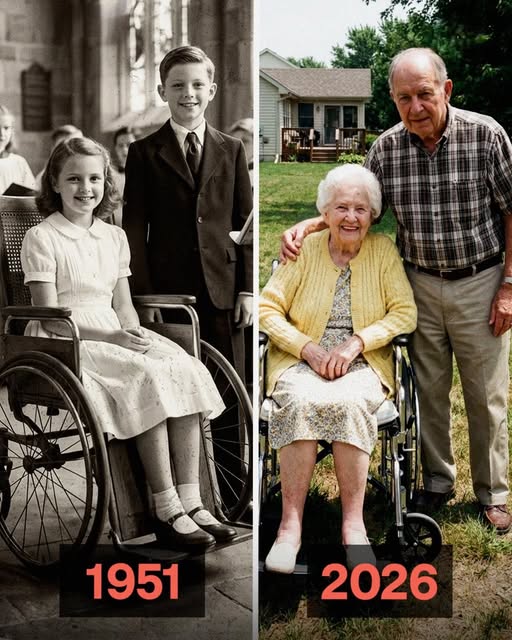
In 1951, Evelyn Monroe had believed her life was over.
The accident happened on a snowy road outside their small Ohio town. Her father lost control of the truck. Evelyn survived.
Her legs did not.
By spring, she was sent to Saint Agnes Rehabilitation Hospital, where broken people learned how to live in broken bodies.
That was where she met Dorothy Bennett.
Dolly.
Dolly was sunshine in human form.
Wild curls. Bright lipstick. Loud laughter that annoyed nurses and made patients smile anyway.
Unlike Evelyn, Dolly had not been injured in an accident. Polio had taken her mobility slowly, cruelly, over years.
Yet Dolly still dreamed boldly.
“I’m going to see Paris someday,” she told Evelyn one night.
“You can’t even leave this hospital.”
“Details.”
Evelyn laughed for the first time in months.
From that moment, they became inseparable.
They whispered through sleepless nights.
Shared secrets.
Shared fears.
Shared dreams they were terrified would never happen.
They made promises too.
When they left the hospital, they would stay friends forever.
No matter what happened.
But life has a way of scattering people before they realize they are being lost.
Dolly left first.
Evelyn still remembered watching her disappear through hospital doors with tears in her eyes.
“Write to me!” Dolly shouted.
“I will!”
And for a while, they did.
Letters arrived every month.
Then every few months.
Then once a year.
And eventually…
Nothing.
Life swallowed them whole.
Evelyn met Martin Harper in 1958.
He was handsome in an awkward way. Too tall. Too serious. Terrible dancer.
But he looked at Evelyn differently than other men did.
Not with pity.
Not with careful politeness.
Just love.
Pure and uncomplicated.
One evening after their third date, Evelyn finally asked the question haunting her.
“You don’t mind the chair?”
Martin looked confused.
“The chair is where you sit,” he said simply.
“That’s not what I mean.”
He became quiet.
Then he knelt beside her wheelchair and took her hand gently.
“Evelyn,” he whispered, “when I look at you, I don’t see what was taken from you.”
His eyes softened.
“I only see what survived.”
She married him six months later.
And for decades, he kept proving that love.
Through pregnancies.
Financial struggles.
Surgeries.
Miscarriages.
Arguments.
Gray hair.
And every ordinary Tuesday in between.
So how could there be letters?
Why hide them?
Why Dolly?
Evelyn sat trembling at Martin’s desk while Clara slowly opened the first envelope.
The handwriting was unmistakably feminine.
Dear Martin,
Thank you for telling me about Evelyn’s garden. I can almost picture her there among the roses. Sometimes I still remember the girl she used to be before pain taught her to hide herself…
Evelyn’s stomach twisted.
There were hundreds of letters.
Some from Dolly.
Some from Martin.
Spanning nearly forty years.
Clara looked horrified.
“Dad was having an affair?”
“No.”
Evelyn said it instantly.
Certain.
“No… not Martin.”
But if not that…
Then what?
She kept reading.
And slowly, heartbreak transformed into something stranger.
Something harder to name.
Years earlier, Martin had found Dolly accidentally.
Evelyn never knew this.
One afternoon in 1974, while cleaning the attic, Martin discovered an old hospital photograph tucked inside a book.
Two teenage girls smiling at the camera.
One in a wheelchair.
One standing beside her.
On the back, Evelyn had written:
Me and Dolly. The bravest girl I ever knew.
Martin became curious.
That night he asked casually, “Whatever happened to Dolly?”
Evelyn’s expression changed instantly.
Pain flashed across her face so quickly Martin almost missed it.
“I don’t know.”
Then she changed the subject.
But Martin never forgot that look.
Over the years he noticed things.
How Evelyn avoided talking about her teenage years.
How she quietly cried whenever she saw girls dancing in old movies.
How she smiled less whenever conversations drifted toward “what might have been.”
Martin loved his wife fiercely.
And because he loved her, he mourned the invisible grief she carried.
The grief she never spoke aloud.
So one day, without telling Evelyn, he searched for Dolly.
It took months.
Then years.
Finally, he found her living in Maine.
Widowed.
Alone.
Still funny.
Still stubborn.
Still remembering Evelyn.
Their first letters were cautious.
Then emotional.
Then deeply personal.
Martin told Dolly about Evelyn’s life.
Her children.
Her kindness.
Her sadness too.
And Dolly wrote back with stories about the fearless girl Evelyn used to be before tragedy convinced her to become smaller.
“You should have known her then,” Dolly once wrote.
“She laughed louder than anyone in the room.”
Martin cried reading that sentence.
Because he realized something terrible:
The woman he adored had spent decades surviving.
But part of her had stopped truly living long ago.
So Martin made a choice.
Perhaps a foolish one.
Perhaps a loving one.
Perhaps both.
He never told Evelyn he had found Dolly because he feared reopening old wounds.
Instead, he became a bridge between them.
He carried stories back and forth.
Photographs.
Memories.
Pieces of a lost self.
Sometimes Dolly sent advice.
“Tell her she still deserves beautiful dresses.”
“Remind her she was always brave.”
“Don’t let her disappear into motherhood completely.”
And unknowingly, Martin listened.
He encouraged Evelyn to paint again.
To travel.
To garden.
To laugh louder.
To stop apologizing for needing help.
For forty years, Martin and Dolly wrote to each other.
Not as lovers.
Never that.
But as two people devoted to the same woman.
One loved the girl Evelyn had been.
The other loved the woman she became.
And somehow, through secrets and mistakes and tenderness, they tried to protect both versions of her.
By evening, Evelyn sat silently with tears rolling down her face.
Clara whispered, “Mom… are you okay?”
“I don’t know.”
She looked down at Martin’s final letter to Dolly, written only weeks before his death.
His handwriting shook with age.
Dear Dolly,
I think my time is nearly done. Before I go, I need you to know something. Loving Evelyn has been the greatest privilege of my life. But sometimes I feared I only knew the woman shaped by pain. You helped me find the girl underneath. Thank you for keeping pieces of her alive when she could not. I hope someday she understands why I kept this from her. I was never trying to deceive her. I was trying to return something life stole too early.
Evelyn broke.
Not from anger.
Not completely.
But from the unbearable realization that her husband had seen sadness inside her she spent decades pretending did not exist.
And worse—
He had carried that sadness for her.
Quietly.
Alone.
Weeks later, Evelyn asked Clara to drive her to Maine.
To find Dolly.
The nursing home overlooked the ocean.
Dolly was ninety-one now.
Fragile.
Silver-haired.
Still wearing bright lipstick.
When Evelyn rolled into the room, Dolly stared in shock.
Then tears filled her eyes.
“Oh my God,” she whispered.
“Evie?”
Evelyn had not heard that nickname in seventy years.
And suddenly the years between them collapsed.
They cried.
They laughed.
They held each other’s hands like frightened girls again.
Finally Evelyn asked the question sitting heavily in her heart.
“Why didn’t either of you tell me?”
Dolly looked down sadly.
“Because Martin loved you.”
“That’s not an answer.”
“Yes, it is.”
Dolly squeezed her hand gently.
“He worried reconnecting would hurt you. At first he planned to tell you after writing me once or twice. But then years passed. It became harder. Then impossible.”
Evelyn closed her eyes.
“He should’ve trusted me.”
“He should have.”
Silence lingered.
“But he also spent forty years trying to help you remember who you were before life wounded you.”
Dolly smiled softly.
“And maybe he succeeded more than either of us realized.”
That night, back at the hotel, Evelyn sat alone beside the window watching the ocean.
For months after Martin’s death, she had been furious at him for leaving her behind.
Now her anger became something more complicated.
More human.
Martin had lied.
Yes.
But not for selfish reasons.
Not for excitement.
Not for romance.
He had simply loved her imperfectly.
And perhaps that was the truest kind of love there is.
Not flawless.
Not cinematic.
But deeply human.
Messy.
Tender.
Afraid.
Sacrificial.
Real.
Evelyn finally understood something people rarely admit:
The people who love us most are still ordinary people.
They make mistakes.
They hide things.
They fail.
And yet sometimes, even in their failures, there is extraordinary love.
The following spring, Evelyn planted roses beside Martin’s grave.
Dolly visited once before passing away peacefully that winter.
The two old women spent hours laughing like teenagers.
Talking about boys.
Hospitals.
Dreams.
Pain.
Life.
And the strange ways love survives.
Before leaving, Dolly hugged Evelyn tightly and whispered:
“He adored you, Evie. Every version of you.”
After Dolly died, Evelyn found one final envelope among her belongings addressed to her.
Inside was a faded hospital photograph from 1951.
On the back, Dolly had written:
You were never broken. Only changed. And still worth loving completely.
Evelyn cried harder than she had in years.
But this time, the tears felt healing.
Years later, Clara would tell her own children this story.
Not as a story about secrets.
But as a story about how complicated love can become over a lifetime.
Because real love is not perfect honesty every moment of every day.
Sometimes it is carrying another person’s pain carefully in your hands.
Sometimes it is protecting memories too fragile to touch.
Sometimes it is trying your best—and failing beautifully anyway.
Moral of the Story & Life Lesson
Love is not always simple, clean, or perfect. Even good people make mistakes while trying to protect the people they love. A long life together does not mean knowing every secret—it means learning to understand each other’s wounds, fears, and silent sorrows.
The story teaches us that:
- People often hide pain behind strength.
- True love is not about perfection but compassion.
- The past never fully disappears; it shapes who we become.
- Forgiveness does not mean forgetting—it means understanding.
- Sometimes the greatest act of love is helping someone remember who they were before life hurt them.
Most importantly:
Never assume someone has stopped needing kindness just because they have grown older. Inside every person still lives the younger version of themselves—still hoping to be seen, remembered, and loved.