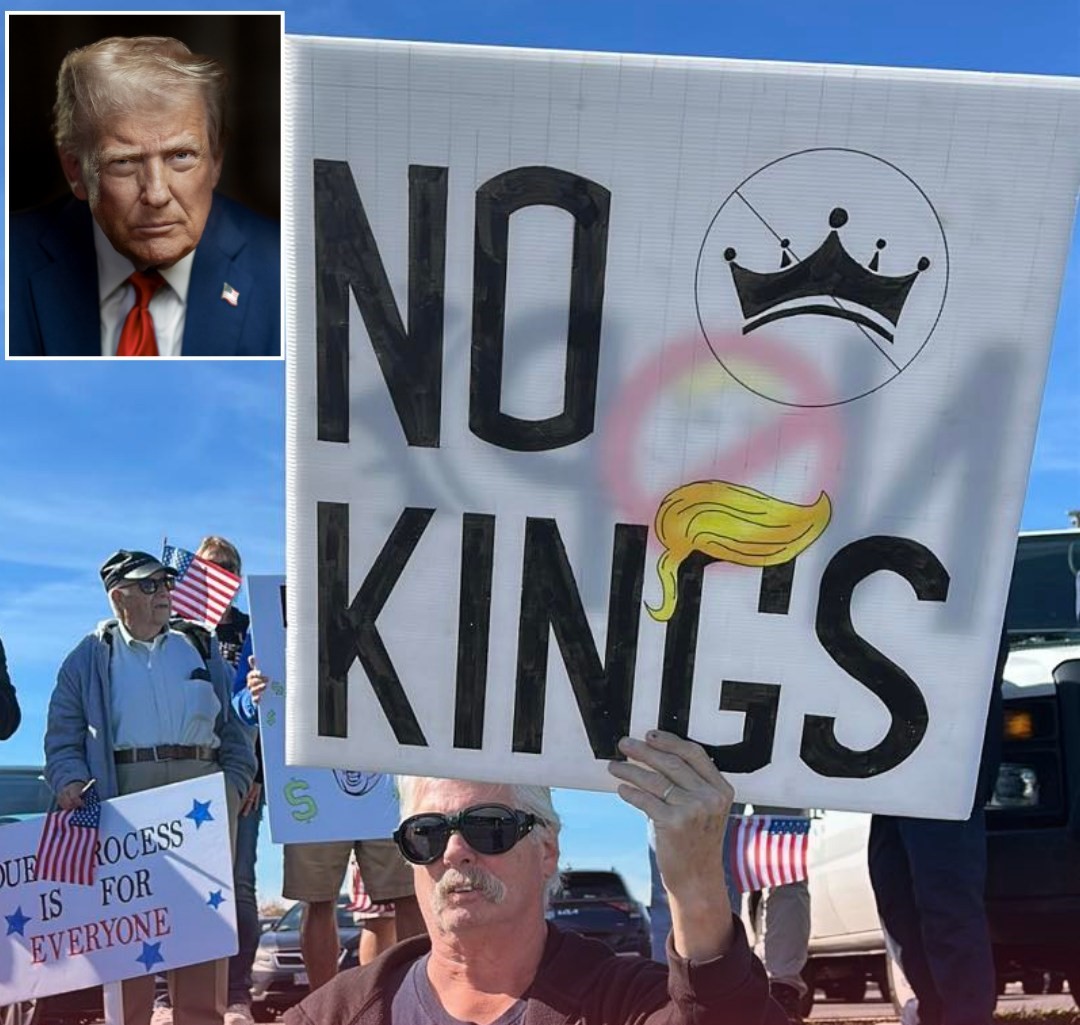
The demonstration outside the Minnesota State Capitol for the marquee No Kings rally, with Bruce Springsteen and Jane Fonda on the bill, wasn’t the most notable development during the day of protests on March 28.
More notable was the No Kings march in Staunton, Virginia. And Salisbury, Maryland. Rockford, Illinois. Beaver, Pennsylvania. Eugene, Oregon. Chillicothe, Ohio. Port Huron, Michigan. Flatwoods, West Virginia. And more than 3,000 other places across the country, plus a scattering around the world.
“A divine entanglement of democracy,” Sarah Elizabeth Greer, 56, called it as she marched in Manhattan, pushing her two tiny dogs in a cart festooned with a pair of handwritten signs: “NO barKING” and “BITE the Power!”
The left-leaning protests with the Revolutionary-era call against President Donald Trump as a would-be monarch and authoritarian had the broadest geographic reach of any single-day protest in the United States in more than a half-century. They included not only familiar precincts in New York and Los Angeles and Austin but also communities in all 50 states and every congressional district, including rural and Republican areas.
While the mood was generally sunny and marches largely peaceful, the third No Kings protests were an unmistakable display of political force that could reverberate in the 2026 midterms and beyond.
In the wake of Republican defeats in a string of special elections − including a Democratic victory in the Florida state House race to represent the president’s home district − the record-setting protests were one more omen of upheaval ahead in November’s midterm elections.
By the way, a twilight rally in West Palm Beach, Florida, included a march down President Donald Trump Boulevard toward Trump’s Mar-a-Lago estate, where the president was spending the weekend. Police turned back the demonstrators before they got close enough to be seen or heard there.
The White House already had dismissed the protests as meaningless.
“Trump derangement therapy sessions,” spokeswoman Abigail Jackson called them beforehand, of interest only to “the reporters who are paid to cover them.” National Republican Congressional Committee spokesman Mike Marinella called them “hate America rallies.”
Here are some takeaways from the latest and largest protests coordinated by the loosely organized group called No Kings.
1. The turnout was historic
It was among the largest protests in American history.
The organizers’ crowd count, not verified by independent analysts, put the total at 8 million people, topping the 7 million estimated at the previous No Kings day, in October. This time, there were more events scheduled − 3,300 versus 2,700 − and larger crowds were reported in some places, boosted in part by opposition to the war in Iran.
The only larger single-day protest ever held in the United States was the first Earth Day in 1970, when an estimated 20 million participated in environmental rallies and teach-ins.
Consider this: In a nation with a population approaching 349 million, the participation of 8 million people means that more than 1 of every 50 U.S. residents joined a No Kings rally.
Organizers said two-thirds of participants who signed up live in suburban, small town or rural areas. That’s a 40% increase over last time in protesters from outside big cities.

The first No Kings rallies were held less than a year ago, on June 14, the day Trump presided over a military parade in Washington marking the U.S. Army’s 250th anniversary, which also happened to be his 79th birthday. Those protests drew about 5 million people, a number affirmed by the Crowd Counting Consortium sponsored by Harvard and the University of Connecticut.
Four months later, the second No Kings marches drew an estimated 2 million more.
The profusion of locations for the third demonstrations means the marches may have commanded less national news coverage than iconic protests that centered on Washington, including the civil rights March on Washington in 1963 and the antiwar Vietnam Moratorium protest in 1969.
But the fact that the rallies were in local plazas and the marchers headed down hometown streets also, presumably, makes it more difficult for critics to dismiss the protests as the province of radical liberals from the East and West coasts.
2. The messages were mixed
The protesters were united by opposition to Trump and support for democratic institutions they accuse him of endangering.
In Columbus, Ohio, Beverly Vogely, 86, waved at passing traffic a printed red-white-and-blue sign that read “Stop Trump, Save Democracy.” In Wilmington, Delaware, a man held a handwritten message on a piece of brown cardboard: “Kings Fall when People Rise.”
The choice of Minnesota for the flagship rally reflected the broad opposition to the sweeping immigration raids by ICE officers in Minneapolis and elsewhere that have ensnared some U.S. citizens, incarcerated thousands of undocumented migrants, divided immigrant families and resulted in mass deportations.
But the No Kings movement doesn’t have the point-by-point platform of a political party, and there was also a mix of priorities and potential conflicts on tactics and priorities.
Protesters’ signs opposed the war in Iran, decried the cost of housing and health care, supported Ukraine in its war with Russia and raised the Jeffrey Epstein scandal. Some of them called for Trump’s impeachment. “Arrest Them!” demanded a banner at one of the marches in Washington, DC, listing the names of Vice President JD Vance, Secretary of War Pete Hegseth, White House Press Secretary Karoline Leavitt and others.
At some rallies, there were signs to “Abolish ICE.” A Palestinian flag waved among the crowd at one of the marches in Washington, DC.
3. The protesters were anti-Trump but not necessarily pro-Democrats
Being united against Trump didn’t automatically mean everyone in the crowd was in favor of Democrats.
The No Kings movement hasn’t depended on the Democratic Party to organize its protests; it’s built its own infrastructure using social media and digital resources. The coalition of labor unions, progressive activists, civil rights groups and others who sponsor it include established organizations such as Public Citizen, MoveOn and the Human Rights Campaign and newer groups such as Indivisible and 50501.
They have appealed to progressives who find the Democratic Party too moderate as well as to the rising tide of independent voters, some of them centrists, who have been disenchanted by both major parties.
“Eggs are Expensive BC All the Chickens Are In Congress,” read a woman’s sign in Rehoboth Beach, Delaware.
With the rallies over, the differences in ideology could complicate efforts to deliver their votes.
4. The protests could matter on Election Day
History says mass protests can matter in midterm elections, unleashing political energy and stoking voter intensity.
The Tea Party protests that began to erupt in 2009 among conservatives opposed to President Barack Obama were credited with boosting Republican turnout in the 2010 midterms, when the GOP gained 63 seats and control of the House of Representatives in a red wave.
The Women’s March in 2017, sparked by Trump’s first inauguration, contributed to a blue wave in 2018, when Democrats flipped 41 seats and regained the House.
Now Democrats are increasingly confident they will flip more than the three seats required to regain control of the House in November. The prospect of winning control of the Senate, where the 2026 map favors Republicans, now seems conceivable but still unlikely.
Democratic hopefuls for office attended some of the rallies, from mayoral candidate Josh Boschee in Fargo, North Dakota, to potential presidential hopeful Pete Buttigieg in Traverse City, Michigan.
5. Beware the blowback
That said, mass protests also carry some electoral risks.
Protests against the Vietnam War galvanized young voters and liberal Democrats. But the blowback from older and more conservative voters fueled Republican Richard Nixon’s law-and-order appeals in 1968, a race he narrowly won over Democrat Hubert Humphrey.
More recently, the conservative Tea Party takeover of some GOP organizations led to the nomination of untested and unvetted contenders in Delaware, Nevada and elsewhere who then struggled to win statewide elections. Most analysts think that cost Republicans their chance to regain control of the U.S. Senate in 2010.
Now some Republicans are depicting the No Kings movement as a band of radicals, out of step with mainstream political opinion. House Speaker Mike Johnson said it had brought together “the Marxists, the Socialists, the antifa advocates, the anarchists, and the pro-Hamas wing of the far-left Democratic Party.”
Marinella said the rallies “are where the far-left’s most violent, deranged fantasies get a microphone and House Democrats get their marching orders.”
While the rhetoric against Trump and his policies was scathing, most of the marches had a good-natured air and featured a fair number of costumes, including a variety of inflatable versions of the president. At the Morristown Municipal Building in New Jersey, an oversize inflatable frog danced at the head of the crowd. In Nashville, a dozen women donned scarlet “Handmaid Tales” robes, carrying a sign that said “Shame.”
In Palm Beach Gardens, Florida, a quartet of women wore faux Statue of Liberty crowns, carrying plastic versions of her lighted torch.